



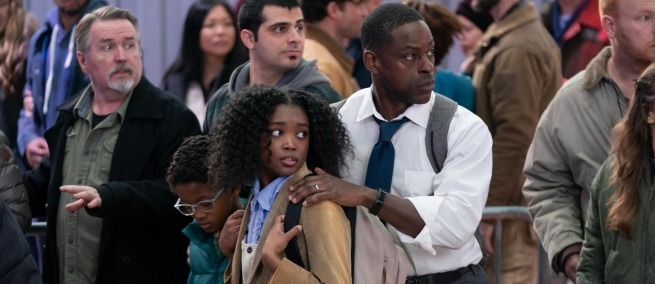
Dr. Jonathan Mijs, a professor at Boston University, is a scholar of social inequality. Dr. Mijs served as a technical consultant to the Hulu series PARADISE, now in its second season. The show stars Sterling K. Brown as a secret agent investigating the murder of the President. He lives with tens of thousands of people in an underground bunker in Colorado that they’ve retreated to following an extinction-level environmental catastrophe above ground. We spoke with Dr. Mijs about his work on the show, how he applied his research to the questions the writers were asking, and why he thinks film and television are important for engaging with critical scientific topics.
Science & Film: To start, I'd like to know how you got connected to the show, and what your role was.
Jonathan Mijs: All of this started three and a half years ago. I think someone from Dan Fogelman's production company reached out saying that he was excited to chat with me. I made myself available. And I was projected into a meeting room in LA with a bunch of sofas and, you know, people kind of lounging. The writers started peppering me with questions that were quite far-reaching. But essentially, they were all questions about equality and what a perfectly equal, egalitarian, perfect society would look like.
Now, I spend my days mostly thinking about everything that's wrong with society, all the societal ails that plague our world, and have made a research agenda of documenting how people understand those inequalities in their society, how they feel about it, and what makes people come to, if not wholeheartedly accept, at least allow this state of inequality to increase. For wealth to get a lot more concentrated and the gap to grow. This has been the story of a lot of Western societies over the last half a century. So there's a puzzle there, as in, how are people accepting this? I gave a TED talk on the topic years ago in London, that’s on YouTube. I think that's how they [the production] located me.
So here I was having to answer all of these, some, of them quite impossible questions about pretty much the opposite of what I normally work on, which is everything that's wrong with our unequal world. Here, I was asked to think about what would the opposite of that look like? What would a flourishing, egalitarian paradise look like? I found myself drawing from science fiction, drawing from philosophical thought experiments, but I also started thinking about where can social science research come in. What are some of the ingredients that we can draw on? After a couple of these sessions, after the series was green lit, I was commissioned to basically write a White Paper–that's what academics do, right? We write papers. So I wrote 30 or 40 pages trying to answer as best as possible all of these various questions. Given the scenario that a bunch of really wealthy people with almost unlimited resources are coming together to build this bunker society, that provides an opportunity for something like 30,000 or 40,000 people to rebuild society, how would one go about constructing, arranging this society, socially, politically? And how do you even go about selecting and deciding who gets to live in that society in the first place? Really big and impossible questions, but I found myself drawing on, in effect, the whole discipline that I come from: sociology.
It is this discipline that came out of the 18th and particularly 19th century, as Western societies were confronting these enormous changes of industrialization, of urbanization. The world was rapidly changing. And these thinkers were very much trying to answer these similarly broad questions about, for example, what's the role of religion in a society that is being changed by technology? Under all this rapid change, how do people stick together? Where do you find social cohesion when things are moving so quickly? How does power operate in a way that make people accept authority as legitimate? How do you create social order? As Emile Durkheim the French sociologist put it, how do you protect against a centrifugal force in society, and keep people together without making them feel that they're suffocating? How do you find that perfect balance, right?
So that’s basically what I did in that paper, go back to those early insights from those 19th century thinkers. Sociology is not social engineering. We do not have perfect answers to any of these questions. But we do have some kernels, some guidelines. And those are what I tried to put together in that report. So that ended up being some sort of food for thought, some of the fuel for the people in the writer's room.
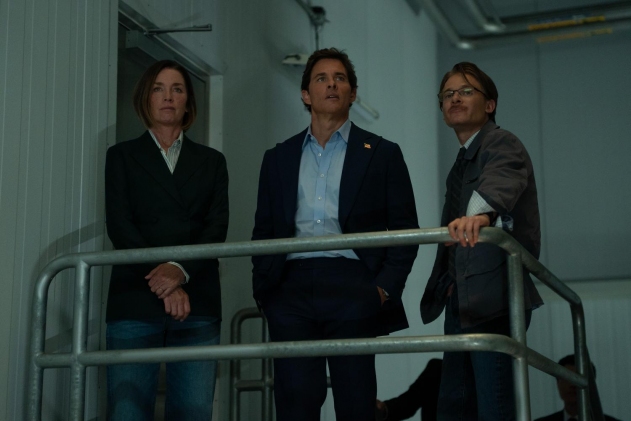
Still from PARADISE
But, around the time that I was having these conversations, that's when the writer's strike happened and the actor's strike. So that was a huge pause. In fact, I thought that was the end of the project altogether, to be very frank. I didn't hear anything for a long time, obviously, until all of a sudden, I learned that things had restarted and then very quickly moved into production. Before I knew it, PARADISE had come alive and like any other enthusiastic audience member I got to sit there and watch how they took some of my ideas, brought in a lot of their own ideas, and ran with it. So that's how I've been enjoying the show, looking for traces of all those big question conversations that we've had, but, ultimately, also just enjoying the show for what it is, which is a cool dystopian thriller.
S&F: How much did you know about the premise of the show and where they were going with it?
JM: I knew the premise of the show and the storyline of the first season. I knew nothing about the second season, and I knew nothing about the details. I think I made this observation watching the show on the couch with my wife, and she immediately called me out for saying that my ego had gotten way too inflated, but there's this moment in the show where there's this European-sounding scientist flown in to help think through the development of all this [the bunker society]. And I'm like, did they kind of base this person, off of me? Is this how they saw me? In a similar way, I was invited to help think through the social engineering part of it, which, again, I'm ill-equipped to deliver on but that part of how do you socially, sustainably, create a society like this without knowing a lot of the important details? I think that's true for that character in the show, and it's very much true for me and my role as a technical consultant.
S&F: Any tips on what makes a successful society?
JM: I mean, yeah, it's hard, right? Because ultimately, as we learn as we watch the show, it's not a democracy, it's an oligarchy. There are a lot of things that look very harmonious and kind of perfect that ultimately fall apart. If I were to give some advice to people trying to keep everyone happy, first of all, you need to select people that are skilled, that have something to bring to the equation, that are talented, but you cannot just select people based on skills, based on talent? Then that that would mean having to sacrifice their families. That would mean having no place for so-called dependents. And what you can see in the show is that they've fully acknowledged that. The fact that one of those crucial dependents did not make it, Teri, Xavier's wife, is one of the biggest plot points. That motivates him to leave paradise, right? That's something that we can find in our current society, too. I think most everybody fully subscribes to the meritocracy. But, once you start thinking about what it actually entails, and you start to see how that actually conflicts with a lot of other important principles that we do subscribe to in our society, things like equality. You cannot just have merit take over everywhere. What about need? Does a child need to prove their deservingness of care, of food, of nourishment? That's fully unreasonable, and very much the opposite of what many people's intuition would say. You see that in the show they try to find a way to kind of reconcile those things.
Also, you see that there's a big emphasis on ceremonies and bringing people together. When the President passes away, everybody gathers in the stadium. There's remembrance. Those are really important things, and we see that in our society too. It's important to mark important moments, whether they're positive moments, like a graduation ceremony, or whether it's hardship like a death. You see the importance of these broader stories and narratives that give meaning to what this whole society actually is. These are the survivors. These are the people who are going to rebuild Earth. And as soon as it becomes clear that that's not entirely true, that there are other people out there, things very quickly fall apart. That also, I think, speaks to the importance of the idea of “American exceptionalism,” or like we are “the country of the free and the brave,” etc. Those are important cohesive forces in our society. And once people start puncturing holes in that, that is quite a threat, because if those kinds of narratives fall apart, then our collective identity falls apart. And with that, I think, the legitimacy of the political project. So, a lot of those things entered into the show in a very nice but nuanced way. Those are some of the ways in which I saw my own input be reflected in the show.
S&F: Do you know if there were other consultants on the show?
JM: There's one, an author who's written about environmental catastrophes. Then, more broadly, they were able to pull on real-life things, like billionaire bunkers. That's not an invention of the show. We do see that people are actively preparing for these kinds of scenarios. And by people, I mean a very, very select number of people who have those extraordinary fortunes and means and resources.
S&F: In the second season, the bunker in the Post Office feels more attainable for people without huge financial resources.
JM: Actually, I started realizing only after I started working on this show, how many nuclear fallout bunkers are still around me here in Boston. That was very much built into our society during the Cold War. You still see those logos sometimes on buildings, and there's a metro station around here where you need to go really deep into the ground, because that's one of those sorts of bunkers. So there was a lot of this that is not all that distant, but it's almost virtually erased from our memory.
Still from PARADISE
One more thing I want to say, is that I found it really enjoyable to be able to give scientific input into the project. But I should also readily admit that there’s a lot that the world of cinema, television, and art, more broadly, has to offer. There's only so much that scientists can contribute to painting a picture of a fairer, more egalitarian society. And there's a lot that artists can do. I think holding up that mirror of where our society is, there's only so much tolerance for lecturing people or providing the facts and writing reports and all of that. Whereas entertainment media are, I think, very effective tools to actually entertain people, but also make them think and perhaps reconsider and paint those pictures. I'm heartened by the success of this genre of dystopian science fiction, in particular. Think about movies like PARASITE or MINARI which is a little more nuanced. And then, all the other things, like SQUID GAME and such, SILO which actually resembles the premise of this show.
I've started with my students to bring together a lot of these utopian and dystopian sort of imaginaries in one place. We called it the Utopia Observatory, where we're pulling from film, television, but also literature and other sources, to bring these things together. I think those imaginaries are quite powerful in a way that dry facts and science sometimes just aren't. More from Sloan Science and Film:
SHARE