


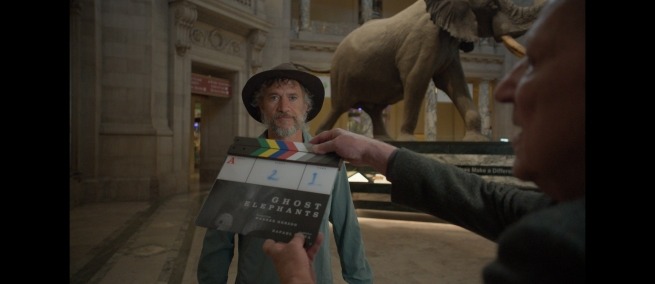
The new Werner Herzog documentary GHOST ELEPHANTS follows National Geographic Explorer and conservation biologist Steve Boyes as he searches for the “ghost elephants of Lisima,” believed to be the largest living land mammal. The film premiered at the Venice Film Festival and will air on National Geographic on March 7. We spoke with Boyes about going on expedition with cameras, how film figures into his work, and his passion for science.
Science & Film: I wanted to start by asking why you wanted to be in this film, and how the presence of the camera changes your work?
Steve Boyes: It's been since 2010 I had a French cameraman join me, and we went and filmed the first crossing of the Okavango, an ancestral route that hadn't been used for a generation. And ever since, we've had cameras with us. I'm a scientist, but I do understand that science needs narrative. It needs personality.
You know, you put a camera up, you set it up nicely, and you put the mic and we talk about the ancestors and we make it all about him around the fire and he tells some stories about his father and his grandfather and the migrations. He realizes that in telling it in that circumstance with a big camera, it's a really good story. And then you find him in the village later on, telling the same story. You build these storytellers. We do filmmaker expeditionary storytelling workshops across Africa now, six participants per workshop, we'll get between 1,000 and one and a half thousand applicants per workshop. We'll do them in South Sudan and the Democratic Republic of Congo, Botswana, Zambia, Tanzania, all over.
Eric Averdung, who was the cinematographer for GHOST ELEPHANTS, he's 25 years old. He came to Botswana to do a workshop with us. He was a safari guy teaching tourists how to use a DSLR camera. And we just found someone that had this extraordinary eye and work ethic, because you take them on a simulated expedition, they're doing character studies, storyboarding, gear, edits, and then color and sound grading and all that. And he just shone. So now he's the DOP on a Werner Herzog film 18 months after doing a workshop with us. So our legacy across Africa, with the great spine of Africa, the Okavango Wilderness Project, is, you know, not just the river guardians and the ecologists and the scientists and all of the bursaries and scholarships we do. It's also the storytellers telling stories about the river guardians, the scientists, the science, the discoveries, the risks, and the actions we need to take.
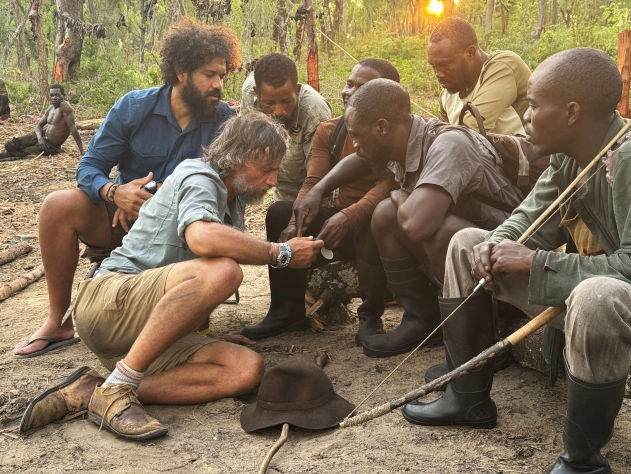
S&F: That's amazing. One of the scenes that stood out to me is when the Ghost Elephant is captured on a cell phone and not one of the bigger cameras. Can you talk about shooting in the field and those choices?
SB: There's a couple other scenes, like the one when I'm drawing the footprint in the sand, that's on an iPhone. And Averdung intentionally wanted that, because he wants to be in it. When we're doing the trance dance, you know, he's uncomfortably in there, you know, inside the dance.
I mean, when we're out there, you're not allowed to say who's going with you, where you're going, or when you're going. So it was on the second day of the search documented by Averdung, which was two and a half, three months. And I went with my notepad, and then they banned me from walking and searching for two days. I went and camped away from camp. I sat off and like, it was punishment. And what you see in the film at the end there is, we've given up. We don't take any cameras.
When you go for a search, you come back to camp, no one talks to you for an hour, you decompress, and that is a cultural thing, and then we will do very dense and open and interactive sharing of what happens. And I remember getting back there, and I ate some rice and beans, and it was like, I was in a trance. I didn't know what to do. It was a powerful, powerful experience. I can't stop going back. I went back in September, and I had a helicopter--first time flying over because it's very difficult. And I just wanted to jump out there. There it is, I can see such a remote, mystical, magical valley. And I just wanted to kind of jump out and go down there. It's an extraordinary place, extraordinary.
I always say we're obsessed with Marvel superheroes and the thoughts of that, and we dream and imagine all of that a lot, you know. But our only superpower as human beings is being in nature and its effect on us. I used to have on expeditions, three spots for creative people, where it would be a data artist, conceptual artists, you know, photographers and filmmakers, sketch artists, painters, poets, writers, that kind of thing. And people from all walks of life and of all ages, and every single one of them, within a week, are reckoned super human in their system and way of being, because, you know, it's normal life for Antonio, it's normal life for Twee, to be on the bikes and go out and do this, and it's normal life for all of us. We all think, oh, gee, look at that. I've never met a person at any age that hasn't been able to do that. It seems so inaccessible. And that's what explorers do, but it is built into the resilience of being a human being. We experience it in brief moments in our city-based lives, but it's full on when you're out in those remote environments.
S&F: What is it like to see an hour and a half depiction of such an intense experience? Were you involved in the edit at all?
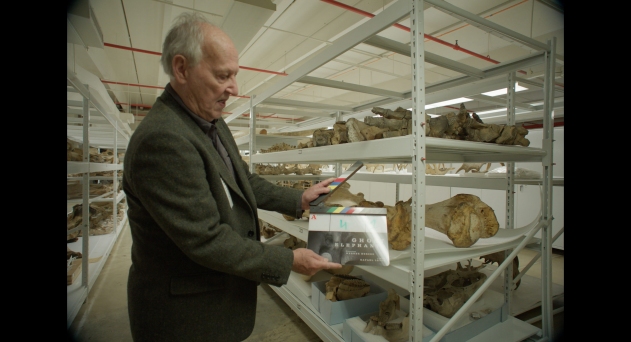
SB: Werner is not really like that. I mean, I did sit in the edit suite that was going through initial footage. Within two days in Namibia, like he's so razor focused on the story you can't budge him, you can't give advice. He's not interested in listening to that. In the build up to that, I've shared poems and books and wrote a lot of five-page letters that are about my first experience of the elephants in the landscape, about the hunt for Henry. I had a team in Portugal do deep research into that whole thing. We went to the archive in Smithsonian, and I shared that with him. But once he's going it's very difficult to budge him on his vision. You come back to America. We're filming at Stanford and at the Smithsonian. He'll film for 45 minutes in the whole day with a giant crew. And the crew is like, can we do coverage? He's like, no, no, I'm done. We'd finished, we wrapped in UC Riverside and two weeks later, I get a link for the film. It's 95% the same as the film you see today. He did it in two weeks, because he knew what it was already.
TOPICS
SHARE