


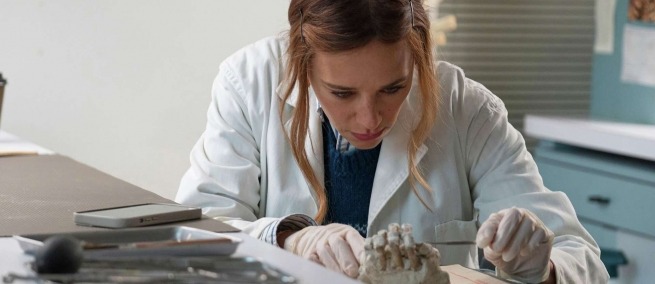
My background is as an archaeologist specializing in Neanderthals, the evolution of technology, and women through prehistory. I’m a trained stone tool - or lithic - analyst. I love the intellectual depth and rigor of research, but I’m equally passionate about sharing knowledge. I began public science writing in 2012, in between my PhD and starting a postdoc. Thanks to writing on my own site and other platforms like The Guardian and Science Blogs, I got noticed and was offered a book contract which became Kindred: Neanderthal Life, Love, Death and Art. Despite coming out in summer 2020 – in the middle of Covid ‘Year One’ – it was a bestseller, published in 20 languages, and seemed to touch a lot of people. Pretty soon I started to get consulting enquiries from television and film producers. I started work on IN THE BLINK OF AN EYE in 2023.
When doing consulting work, whether for feature films, documentaries or even novels, the major challenge is the pre-existing narrative that’s been a key part of the pitch and commission. If that narrative theme or story conflicts with issues around scientific accuracy or realism, then it produces a tension. Is it ethically or morally crucial to ensure as much accuracy as possible? How does that intersect with what the director or writer is trying to create emotionally? As a consultant, answering those questions and making decisions around them isn’t my role. I’m there to provide the most up-to-date scientific information and to fact-check, but also to give wider context for currently accepted ideas, and to suggest how likely or not something might be.
Archaeology is famous for combining elements of the humanities and sciences. We work with partial information that needs to be interpreted, just like historians, and we understand how the formation of our own datasets can result from, and produce, biases. But in doing 21st century archaeology, we also draw on an immense array of scientific methods to help us obtain and analyze things. We excavate sites with forensic-level precision, recording 100,000s of tiny objects in 3D space; we extract DNA, not just from ancient bones, but from the cave dirt itself. And we use complex measurements and statistics and modelling to understand things, from patterns in artefact form, to the age at which a Neanderthal baby was weaned, to the movements across continents of entire populations. Ours is a vast field of enquiry, and it’s dynamic too. Ideas can change dramatically with single discoveries.
My contribution as a science consultant for film and television is partly about having that expert knowledge. But it’s also about being able to share it in a useful way. I need to be able to combine facts with informed inferences, to explain things clearly and succinctly to people who may have no familiarity at all with archaeology or scientific concepts in general. But that’s what makes it enjoyable, because it’s a creative, interactive process. It allows me to bring together my skills as a researcher, and an author and communicator, to help people expand their own imaginations.
The extent of my involvement varies a lot. In some cases, I’ve given feedback on a single version of a script, in other cases it went back and forth through numerous edits. I’ve also had the chance to watch and comment on early cuts. Sometimes everything happens by phone or Zoom, but I’ve also done in-person work, meeting producers, set and costume directors, and coaching actors. In situations like that where you’re being asked hundreds of questions on all sorts of subjects for hours. It can be very intense, but also brilliant fun. Sometimes changes I suggest are taken up and the production evolves differently because of that, but other times they’re not. Of course, if you aren’t part of the writing or editorial team, then those decisions are other people’s responsibilities.
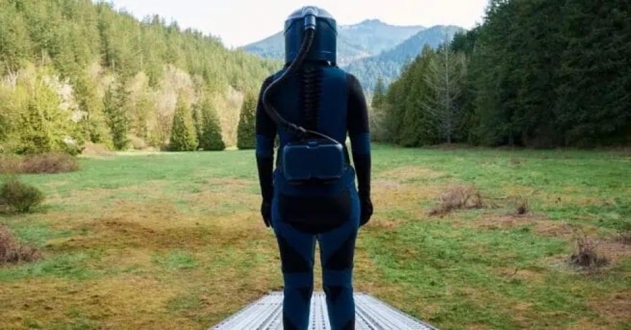
For IN THE BLINK OF AN EYE, I was asked to comment largely on the story which takes place around 45,000 years ago, where a tiny group of Neanderthals seem to be dwindling towards extinction, but their fate is changed by an encounter. In this case, and other productions I’ve worked on, there’s often a desire to represent Neanderthals in relation to early Homo sapiens(our own species). This means that, as well as trying to balance decisions based on what archaeological evidence we actually have versus what else could have been going on, there’s a narrative requirement to try and help the audience understand them as different kinds of humans. That can be done visually through anatomy, costume and props, and also behaviorally: how the species move and communicate.
Clothing is a great example of how tricky this can be in practice. We know from distinctive polish left on their tools, and patterns of butchery marks on animal bones, that skins and furs were being processed by Neanderthals and by H. sapiens, but we’ve never found a permafrost body showing what they actually wore. The nearest thing are figurines carved with what look like hooded parkas, or in other cases nude bodies with belts, bracelets and what might be beaded hats. But these objects are many thousands of years later than the time period when humans overlapped with Neanderthals (they vanished around 40,000 years ago). So, when I consult on costume, I work with the designers to explore what the archaeology tells us, what might have been possible based on knowledge from ethnography, and how their production resources can make this something understandable for audiences.
One of the things that’s hard to get right in Neanderthal productions is their looks. Their facial anatomy was very different from ours, and even with excellent prosthetics, there’s only so much you can change. Digital methods are also possible, skewing faces into a more Neanderthal-like form, frame-by-frame. There’s always a risk of ‘uncanny valley’ effect, but what makes a huge difference is the actors. I always tell productions that Neanderthals had tough lives, but they were emotionally complex beings, just like us. One of my favorite things from IN THE BLINK OF AN EYE is the male character, Thorn, who’s an emotionally-rounded individual invested in his children, and also the actor who plays young Lark is so vivid, recognizable as nother kind of child, just playing with their baby sibling, or worried about a parent.
I love doing this work, and ultimately I see my role not merely in helping productions be more realistic or accurate, but also giving them access to more creative possibilities. We’re collectively trying to worldbuild and tell stories, and the power of humans to connect through time is what archaeological research, writing books and this film are all about. More from Sloan Science and Film:
FILMMAKERS
PARTNERS
TOPICS
SHARE