


Jesse Moss and Amanda McBaine’s TEENAGE WASTELAND is set in the 90s in a small New York town named Middletown. It follows English teacher Fred Isseks who taught generations of students to use camcorders. He also pursued with them an investigation into toxic waste at a local dump. The film premiered at Sundance and is now playing at Film Forum in New York City. We spoke with Jesse and Amanda about why they were drawn to Fred and his classroom, the issue of garbage and toxic runoff, and the impact of Fred’s style of teaching.
Science & Film: How did you guys come to this story?
Jesse Moss: We came to the story about five years ago. There was a profile of Fred in The Guardian that we saw. From there, we went to Fred's blog, which has his kind of lonely struggle to keep the story alive. And from there, we were connected to Fred by a producer that we know, and learned that Fred was interested in having a documentary made. The breakthrough for us was meeting Fred for the first time, just having a conversation with him. He has a kind of ethereal, magical quality to him, which I think you see in the footage. He's just a remarkable person, and we were eager to make a film about somebody who made us feel hopeful in a challenging time.
We connected very personally with this story, because we also came of age in that time period. We're just a little bit older than the kids [in the film], but we also picked up a camera in the early 90s and discovered how powerful a tool camcorders could be. We also were looking for a way to talk about some of the the issues around climate change and our environment, but in a way that felt unexpected and fresh. It's very hard to get people to pay attention to these existential threats. Telling them how big the problems are is not really the way to do it, and this story reduces the problem to a finite point that we could really grasp.
Amanda McBaine: I'm also going to add that when we visited Fred for the first time, he took us down to his basement, and in his basement was 500 hours of archival material, which is a documentarians dream, but he'd also organized it well. All these VHS tapes which would have corroded and are currently all corroding, he'd transferred over to digital. So he's a great steward of his own history, but then was open to a remix with us.
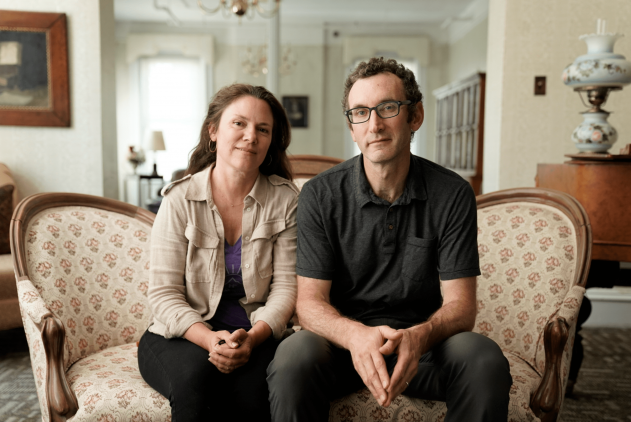
Directors Amanda McBaine & Jesse Moss. Credit: Whitney Curtis
S&F: In terms of Fred's arc, do you see a tension between his wanting pursue this issue in a journalistic fashion and being a teacher?
JM: Fred is, in some ways, a kind of contradiction, and that makes him really interesting. He's a radical, but he's also a teacher in a system and an institution. And we were quite taken with understanding how Fred was radicalized. It was the late 60s and the anti-war movement. Unlike most people of that generation, he didn't lose his radicalism. He became a teacher, but he brought his radicalism not in a preaching way, but in a kind of way to empower. I think he created an extraordinary space, and somewhat by accident. And so the school system thought, well, he's an expert in technology, but he didn't really know anything about it.
I think that the film also gets at the tension between journalism and activism, which is also unresolvable. And I think a great question to wrestle with for audiences. I think personally that journalists are not impartial. I think we're all human. We're journalists, and we have a point of view. And I think being aware of that point of view is important, but also letting your students step forward and discover for themselves what the story is, is really what he did, fundamentally, and I think what we admired so much.
AM: It's important to remind ourselves and you that his class had a lot of kids in it that didn't participate in this particular documentary. They were given a choice, and so it was the kids who gravitated towards this work, this kind of investigative journalism piece. That's the kids who we followed. So I think his learn by doing style of teaching is so effective. We have two teenagers now, one's in college. It's so meaningful and empowering, as Jesse mentioned. I never felt, at least in what I saw and heard from Fred, like kids had to follow whatever his thesis was. That is not him at all. In fact, I think that's anathema to him, because he knows how much teaching was top down.
JM: I think particularly now, that's a value and a way of motivating young people that we wanted to put out into the world and encourage. I mean, schools are different now than they were then, and what you can get away with is probably different, but I hope that the film inspires students and educators to think about how the classroom is used to engage the wider world–not just through books and texts, but through experiential learning.
S&F: I think you guys rebuilt the classroom for the film. Can you talk a little bit about what the effect was of rebuilding it?
JM: Fred puts it profoundly that the classroom is a quorum he calls it. It's a space for imagination and creativity that gives rise to new things. And a classroom is really a stage. We built a classroom, but I think it's also a real classroom, and became one when we brought Fred and these students, now adults, back into that space, and it became both a portal to the past and unlocked memories and emotions that were important for us to bring to life and tell the story. We asked permission and that was important, particularly from Fred. The inspiration came when he drew the classroom. We knew it didn't exist anymore. Fred drew it, and I think that was the kernel of an idea to say, what if we could bring it back to life as a way of paying tribute to what it represented. And so we, with his permission, reconstituted it as faithfully as we could. Everything worked, all the equipment, all the cameras, which was fun, but I think more importantly, it became an active and alive space and that's what we wanted to infuse the film with.
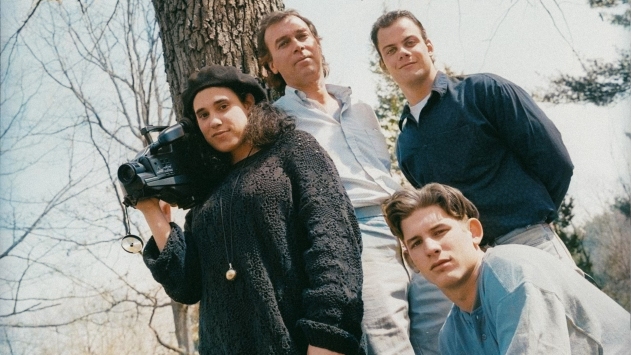
Still from TEENAGE WASTELAND
S&F: In interviewing the students, what did you find was the main thing that had stayed with them from that time?
AM: One of the reasons that we were attracted to this project is because it's such an interesting thing to revisit now, as a middle-aged person, parenting teenagers looking back on, what you do carry forward from high school and what have you buried? What you remember from high school too, like the weirdest stuff, like visually, emotionally, all of the people that we featured in our film had pretty major stuff going on in high school outside of the classroom. That's one of the reasons they needed this clubhouse, right? They needed a father figure, basically, and they needed a project. And they needed a group. They needed, like, a family. And this project had meaning, because everybody as a teenager is looking for meaning. But also, Fred is somebody they really remember, and some of them are still in touch with him, because he was so meaningful to them, to have an adult figure who was such a good force and such an unjudgmental constant for them who also forced them to be their better selves at all times.
I think it's a challenging role, too, that Fred took on, which is to expose young people to the ills of the world in a responsible way. They were confronting corruption and darkness and danger and that's coming of age.
I think for Middletown, the story set in a small town is a story that's much bigger [than its setting]. And I think for us as storytellers, that containment is what made it powerful. The fact that it was small makes it big, I think. And that's what we hope, that whether it's a story of taking political action in your small town and recognizing that democracy is not just over here in Washington DC, but right here in your community, it depends on your own actions. These were things that just felt powerfully resonant right now, and that's our hope, that the movie lands in a moment that resonates and short circuits people's defense mechanisms.
You know, also, no one ever wants to talk about garbage, and it's such a big deal, and we make so much of it. We're not the kind of filmmakers are gonna put a text card at the front explaining how front explaining how many tons of garbage gets created every year, and that's just household garbage, not to mention industrial way. To us, to have made this film that's entertaining, that's character driven, but really this is about garbage on some level too. So you're going to have to think about it for at least an hour and a half. How much do you create and how much are you doing about it? How much do you know about where it goes because it doesn't disappear magically.
I don't like to hit people over their head. I don't think that's what documentary is about. I think it's about meeting people like Fred and these kids. So that's really what we're delivering people for an hour and a half, is like, see these people like you, sort of unknown people who do extraordinary things.
♦
TOPICS
SHARE