



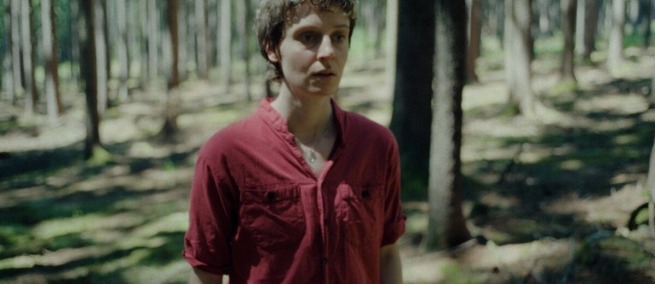
Katharina Rabl’s MEMORIES OF A FOREST, which made its international premiere at the 2026 Toronto International Film Festival, follows a woman returning to her home village where she must contend with the gift, but also the issues, of her newly inherited forest. We spoke with Rabl the day of the film’s TIFF premiere about the role of the forest in her home country and the research she did for the film.
Science & Film: I'm wondering if you could talk about the role of the forest in the region where you set the film?
Katharina Rabl: So the forest itself, the region where we shot the film, and also where the story is centered, it's called Forest Quarter actually. Because its biggest resource is obviously wood, and I was born and raised there, and then I moved to Vienna afterwards when I was 18. So it was really known for its landscape. You go there, you don't see a lot of lakes. It's just forests. And at a certain point, even at the beginning of when COVID spread in Austria, I was a specter at the village of my childhood, and there was the bark beetle infestation. You could slowly see that the farmers and people there in this remote area, they knew for the last decades that something that would never leave is the forests, but all of a sudden something that really was a centerpiece of the landscape wasn't there anymore. I had the feeling I lost somehow the topography of my childhood and was confused what would come next now and what would be the next idea. But at the same time, this kind of emptiness or like this hole, this vacuum that existed now that the forest vanished raised some questions inside myself. Where I thought, okay, what was going wrong in the past, or what decisions were made that we are standing here now and have to realize something that we grew up with is not really fitting into the future. So yeah, there were a lot of thoughts about that, and back then I didn't think that I would make a movie about it. I was just astonished at the emotions that arose in myself.
When it comes to real life, the people there somehow managed to cope with this infestation. They started to plant forests now that are not monocultural spruce forests anymore. But at the same time, nobody really knows which trees are the ones that are good when it comes to climate change and the future. So, it's really experimenting a lot. Forests, I have to say, there are really a lot of them in Austria and that area in private hands, so that can be a blessing and a curse at the same time, because we have still a lot of conventional farmers there, and I don't want to blame them because you know there was a time when they learned from their parents how to take care of the forest, and then inherited that kind of ideology and gave it forward. But now they see they have to make something different. And what you see now is that there are few agricultural people who take care of the forests and who go in a different direction. For example, some of them were encouraged to break the law because if you let the beetle inside, they will fine you. There was a certain time where even like little planes will go up in the air, and they were looking for where's the infestation of the forests, and they will fine you if you don't take care of it and if you don't cut down the trees. So maybe that answers the question a bit. And when it comes to the role of the forest in the movie, I have the feeling that at one point it is a protagonist. I always said because it's called MEMORIES OF A FOREST, and my idea was to tell the story through the forest. That was at least for me the challenge.
S&F: Can you talk about the film’s cinematography?
KR: It's not that we experimented that much with the angle of the camera and stuff like that, but for me it was the challenge: how would the forest look at the family's history because it incorporates so much of the generations before, and I was also interested in how the gaze of the protagonists would change during the time regarding the forest. At the beginning, for me, with being raised also by my grandparents who were farmers, for me a forest is not always meant to stroll through and look at the beautiful landscape. It was an economical resource, you know, and I had the feeling this ideology led in this family to certain kinds of dynamics, and also how people were treated, and people were also perceived as being resources in the countryside. So I had the feeling, okay, there is a similarity between how they look at the forest and how they look, for example, at women, how they labor in the countryside, and I wanted the protagonists to softly change the view on that, and I wanted to make a movie so that the audience can also change their view of the forest, so that you really see in a capitalistic system it's really like a resource where you count every little step of it. But in the end, it also has to exist for itself.
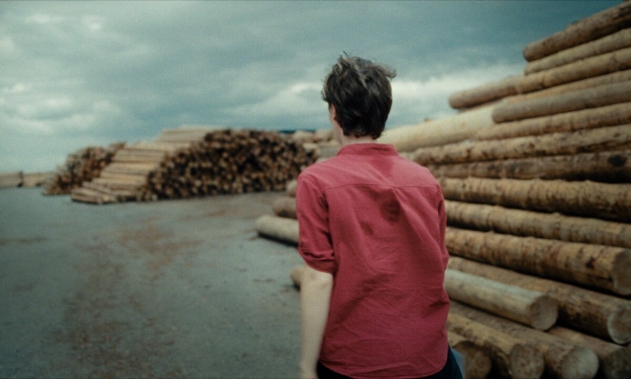
S&F: From the film, it seems like the forest is sort of everywhere, but I don't know if that's actually the scale or that's how it feels in the in the town.
KR: When you make a film, you of course think a lot about world building and architecture, like how you make like a visual architecture of the story you want to tell. So we wanted the forest to look kind of infinite at some points. But yeah, I mean, together with Jakob Kohl, the cinematographer, props for him because he really challenged himself and the screenplay to think about how do we even photograph a forest when it's not this picturesque landscape from a countryside, especially also since the spruce forest has a really conflicting history in Austria and Germany connected to the World War. So I had the feeling that the spruce forest itself is part of a collective identity in German-speaking countries in Central Europe, and we really wanted to film it as thoroughly as possible.
S&F: I really love the scenes when she's learning how to take down the trees and make them into lumber, just that whole process, and how strong she is, and how complex it seems. Is that something that you had any firsthand experience with?
KR: Actually, that was a really great and touching experience for myself because I started writing it down in the screenplay, and to be honest, when I started writing it down, I know how to drive a tractor, but I've never cut a tree. At some point, Karla Cristóbal, with whom I co penned the screenplay, we were both like seeing ourselves writing down: and now she's cutting down a tree. And then I was like, how are we actually doing that with a low budget project? I don't even know technically how it's going to be. And since I'm coming from documentary film, I love research, and so I was happy because my father was a teacher at the agricultural gardening school, and he taught a course: how to fell down trees. Now he's retired, but he did that. So I asked him if he could help me with training the actors. And at some point, I thought they really have to do the labor. I didn't want to and to ask stunt doubles, and the actors were eager to do it. And so, we had a workshop of a few days with my father and with a supervisor who was there for safety reasons, and in this workshop, all of us really learned how to cut down a tree with your bare hands. I think it must be similar to probably slaughtering an animal at some point. For this film, there were like altogether five trees cut down, and they would have been cut down from the region there anyways, because they were infested by the bark beetle. And we worked with different cameras I researched the trees in the beginning, and then we knew, okay, now we can fell them, but it was strange and tough for us because you knew that they were existing longer than me when you were cutting them. For Julia Windischbauer, the main actress, I think for her it was a really important step for preparation, and through the physical labor she could build up the emotional dimension of this role.
S&F: Was there any research that you felt like you had to do about the bark beetle in particular for the film, or you knew enough from having lived with it?
KR: I did a lot actually. There was this research where I would interview farmers in the region. When I started working on the film, it was a small thing in the newspaper and in society. When I was through the years of development and financing and working on the film, I realized it became a huge topic because, as I was saying, it is a big identity thing for the forests in Austria and Germany. It changed in the screenplay because at the beginning I researched a lot and I talked to professionals who take care of the forest, I talked to biologists, and I talked to farmers. I thought at the beginning I really must explain in this film what this infestation means, but then I realized people know already a lot about it, and it's not so much about making a thesis. It's more like the end of a story. The family told itself a fairy tale regarding that forest. The infestation is the midpoint of the movie, and it's the heavy thing, the tragic thing. It's just the really sad and slow end of it. But it depends on how you look at it. If you could see from the perspective of someone who sees the forest from an economical point of view, you would say it harms the forest, but I could identify with the beetle very much because it shows the people where something is going wrong. You could also make the decision to let the beetle inside, and the forest will kind of recover itself.
♦
TOPICS
SHARE