


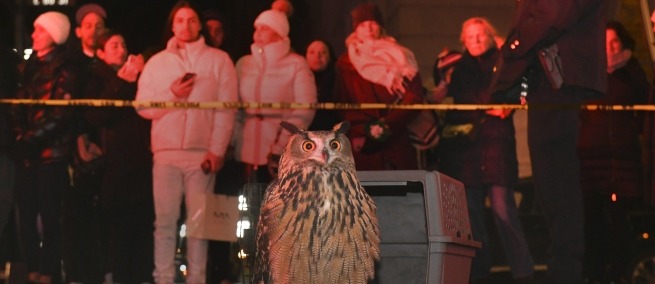
Penny Lane’s new documentary WILD INSIDE tells the story of Flaco, the Eurasion Eagle-Owl, who was released from his cage at the Central Park Zoo and lived throughout Manhattan over the course of a year. Largely crowdsourced from birders dedicated to documenting Flaco, the film tells his story and theirs, raising questions about captivity, freedom, and the lives this bird changed. The film is being released by Sandbox Films and will make its world premiere in Central Park on July 29, followed by a nationwide release.
Science & Film: Congrats on the film, Penny, I loved it.
Penny Lane: It was such an honor to get to make this film. Honestly, like I feel like I was born to make this film more than any other film I've ever made. I feel like this was cosmic. I don't even believe in that stuff, as you know, so for me to say that is very significant.
S&F: Why do you feel that way?
PL: Because you know birds are such a deep, deep passion of mine and have been for like 20 years. It's been 20 years since the day my consciousness about birds switched on, you know, and there's this like beautiful Jonathan Franzen quote about what it's like to have your consciousness switched on to birds. Not everyone has this experience, but people who have had this experience will recognize this feeling. It's just like one day you notice that the world is full of birdsong, that the air is full of song, and that the trees are hung with ornaments. You didn't know that before, and so it's just this magical thing where if you tap into it, it's one of the rare experiences in your adult life where the world becomes more magical instead of less. So I already had this kind of consciousness around birds, and I had been trying to figure out a bird film for years.
In that first night that Flaco was on the sidewalk on Fifth Avenue outside the Bergdorf Goodman and the Plaza Hotel, as Edmund says in the film memorably, the least owly place you could imagine. That night, my friend Jeremy, who now you know because of the movie, he was the first person to see Flaco. He turned the corner, and there he was, and he sent me these pictures, and I was like, "What's going on?" I was intimately, deeply obsessed with Flaco from that instant. He arrived in my life. And then I lost so much sleep those first two weeks, just every night, up all night refreshing Twitter. What's going on with the owl? What's going on with the owl? What's going on with the owl? At that time we had a lot of projects going. We actually didn't have time to take on a new project. But I walked into my producer's office and I was like, "This is our movie. We have to start filming."
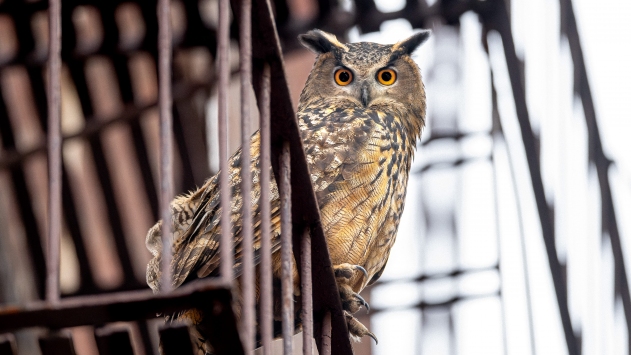
Image courtesy of Sandbox Films, Photographer: David Lei
So, it just felt cosmic. I knew the birding world enough to know that from day one there would be infinite photographs available of this bird, and I knew that there would be people who would follow him around like his own personal paparazzi. He was the most documented owl in human history within like two weeks. It didn't take long for him to ascend to that status. I knew what the film could be from the minute it began in a way that maybe not everyone else would have you known, so it just felt like my movie.
S&F: Since he was so well documented, what did you need to shoot and what did you source?
PL: If you were to count up the Flaco shots in the movie and you were to ask me how many of those shots did like I get with my crew, it's very few. I don't know the actual number, but if we have hundreds and hundreds of shots, we're the like under 10. It's hard to film an owl. You have to A. be able to find him, B. he's in the dark, C. do you have the right camera? I was very aware from day one that it would be a heavily crowd-sourced movie, and that's also something I love doing and have a lot of experience doing. So that also felt like it was in my wheelhouse, and I was like very well adept at doing it. You can't tell from watching the movie that it's just an archive movie, because the archive is present tense and looks really high quality. But it's really just a lot of hobbyists, a lot of amateurs, and a lot of like quasi professionals who love filming birds and love filming owls in particular, which is its own sort of subspecialty.
There's no like main character in the movie that's not Flaco. Flaco is the main character, and that was also special because often when you're trying to tell the story of an animal and make an animal a main character, it's actually quite challenging because, in a traditional narrative sense, to have a protagonist means that you have a main character who has agency, and their decisions are what the story is. The story is driven by the actions of the main character. That's a classical narrative tradition. So, if your main character is an animal and they don't have agency, there's not much of a story. But this guy, as you know, had agency from the minute he appeared on that sidewalk. The things that happen in the story are because of Flaco's decisions. So it was just such an incredible opportunity to have that much access to a wild animal. It was a once in a lifetime opportunity because he was so used to being around people that he kind of stayed on view the whole time, unlike most wild animals who kind of disappear off into the woods and you can't find them. He made himself available to us to be photographed. Someone could tell you where Flaco was every single hour of every day that he was with us, because there was so much interest in his whereabouts.
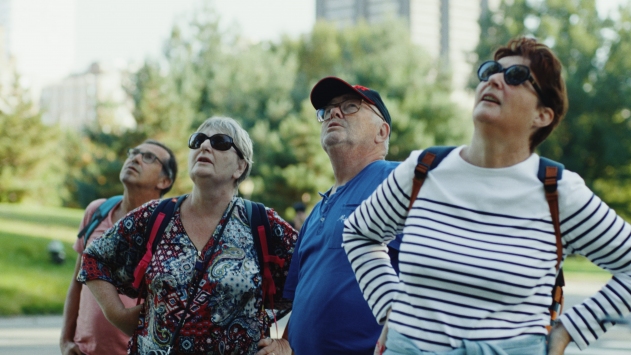
Image courtesy of Sandbox Films
S&F: His story is beautiful but also heartbreaking. I appreciate the way you present both sides.
PL: I was wanting to honor the simple pleasure, the simple joy, the kind of childlike, almost children's story version of the story, which has so much inspiration and so much joy and so much passion in it, while also being like, this is not actually a Disney story. In a Disney movie, there'd be no rat poison. We had to find that balance of the cold hard realities of what it means to be an animal in the world that humans run, but also this kind of magical fairy tale-like story.
S&F: There was also the other balancing act that you present about what should be done with Flaco?
PL: Yeah, what's best for him? That debate was what made me make the film, because I was watching that debate rage largely on Twitter at the time. I was like, "These ethical questions are so interesting, and it's so interesting to see just people in the general public engaging with these questions of like, what is the right thing for this animal?" This is an animal who was not captured from the wild and put in a cage. He was bred to be in a zoo. His parents were bred to be in a zoo. His grandparents were bred to be in a zoo. This was a captive animal lineage. We bred him. We made him exist. We chose to put him in that particular enclosure. Whatever you think about it, we chose that. Another human came along and decided he should no longer be in that enclosure, and they cut open the cage, and they shoved him out. We were responsible for that. We were responsible for the environment into which he was released. What is it like to be an owl in New York City? You know, knowing that every single bird of prey in this city will pretty much die if not of rat poison, then at least with an amount of rat poison in their body that probably had something to do with their death. I really wanted people by the end of the film to ask, well, you loved Flaco how? Did we care for Flaco? Did we give him what he deserved, ever, at any point in his life? These are tough grown-up questions that the children's book Disney version would never have to deal with.
No one was paying attention to him when he was sitting at the zoo for 13 years, and I just think that it's important to remind ourselves that he became an ambassador species once he was free. But that said, you know, we look at that situation, and we think, what's best for Flaco? And the way that we answer that question tells us a lot about ourselves. Would it be a better life to be safe and comfortable and well cared for, and have medical care and not be exposed to the toxins of the urban environment? I think it's reasonable to think the answer is yes. Your answer might be different depending on how you think of your own life and how you balance questions like freedom versus safety. You know what kind of risks are unnecessary and what kind of risks are necessary to like feel that you're living a full life. I'm not an owl. I don't know what an owl would say is the purpose of an owl's life. I don't think an owl thinks that way. I saw Flaco trying to express, to the best of his ability in a less-than-ideal situation, what he thought a good life was, and so I tried to honor that in the story. We saw what he chose and what he didn't choose, and that he died a wild animal. He died the way wild animals in New York die. I think that's very moving. I think that's an important part of his legacy to share, but we tried really hard to at least express in the film differences of opinion around how we should think about all of that. Was this ultimately an inspiring story? Was this actually more tragic than inspiring? Did humans let him down? These are questions I hope people ask themselves, but I didn't try to answer all those questions for anyone.
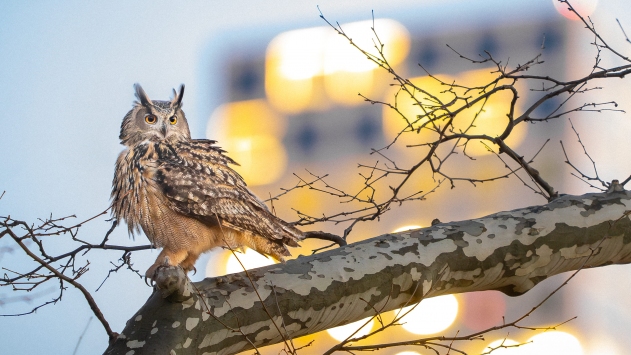
Image courtesy of Sandbox Films, Photographer: David Lei
S&F: Is there a reason why you chose to follow the specific birders you highlight in the film?
PL: Well, because they had the footage I needed, right? It really was the people who were spending the most time with Flaco who also happened to be very good photographers. So it wasn't that hard of a decision. We had all this material of Flaco, hundreds and hundreds and hundreds of beautiful close-up, high-quality images. The birders were not filming themselves, and they were not filming the wide shots, they’re all doing portraiture. So our job then became to create the reverse angles, to create the context around these portrait shots.
S&F: And were you close to any of these folks?
PL: I didn't know any of them. I'm a birder, but I'm like a lonely birder. I'm not like a community birder.
S&F: As the film is coming out, to what extent do you feel like Flaco and his story have endured?
PL: Oh, he's about to endure a lot more. When we dropped the trailer on Instagram, it was a really interesting experience and test balloon to see, are people over this story? Do people know about it? We now have a million views on Instagram, and it's really incredible to see him be introduced to this whole new audience. In the comments section I'm seeing all the same debates raging, people are fighting about whether it was better for him to be in a cage or be free. People are learning about him for the first time and experiencing all the feelings that some of us experienced along the way. So he has endured, to the extent that like people knew who he was when he was alive, he still has a lot of cachet for some people. But I do think actually most people have never heard of this owl, and they're about to for the first time. So involving myself in his legacy is a whole thing.
I miss him every day. Actually, a lot of people still miss him every day. I miss just checking Instagram and seeing what Flaco's up to today. You know, knowing that he was out there doing his thing, I miss that so much. But I'm now involved in his legacy, and that is its own kind of responsibility as it is with any other documentary subject. You want to get it right. You want to make sure people know the relevant facts about him, and how he lived and how he died, and that feels pretty special to be part of that too.
S&F: Do you see this as a New York story?
PL: It is such a New York story. I mean, it could have happened anywhere, but there's the sort of setting of not just New York, but Central Park, with the billionaires' row behind it, and all these kinds of iconic backdrops and buildings. New York is practically a stand-in for the global conception of a modern megacity. You couldn't have found a more ridiculous place to drop a wild animal. So seeing him with those buildings in the backdrop, or even just seeing him with a subway sign behind him or something, there're so many iconic images. I got to spend over a year of my own life like getting to know my own city more and I really appreciate that. It's another one of the things that feels like a real gift with the project, even Central Park is so much more special to me now. And that's why it's so cool that we get to premiere there.
S&F: Are you interacting with the Central Park Zoo in any way?
PL: They chose not to participate in the film--we reached out many times to try to film with them or to ask questions, questions the public was asking, questions that people were speculating about in our interviews. Like, was he always in that little enclosure? Did he ever have time in a flight cage? Did he have enrichment activities? What was his life like? And also, to be clear, I'm sure the people who cared for him loved him and were completely wrecked by the fact that he was set loose, and they were responsible for him, and they had to then live with the idea that he was out there in the wild. I really wanted to share that part of the story, but they weren't interested. They never responded. I have no idea what they will think of the film.
The zoo thing is very important. I didn't come into this project being like I'm anti-zoo or something like that. That wasn't the inspiration, you know? As I said before, Flaco landed on that sidewalk and kicked off this series of events. That's the story I'm telling. I didn't come into it having an agenda. I'm still quite open-minded about these debates. I understand all the reasons why zoos exist and the good reasons for their existing and all these things about conservation. But there's something important that I thought the story told, which is that the instant he was set free, the average everyday person did not want to see him go back. Why? There's never a story of an escaped zoo animal where the public's like, I can't wait for him to go back to the zoo. But you can look at his enclosure and say like, just because it doesn't look good to you doesn't mean it's not good for an owl. Do you really know what an owl needs? But there's something about the average person's reaction that I do think is meaningful, even if it's not informed by like science or animal husbandry best practices. It's that sort of instant, that doesn't seem right, and then you kind of talk to yourself about how it's fine, you know. But also, it's a bird. There's symbolism here, like the bird in the cage, it's not like any other animal. And also, it was an owl, and also it was a handsome owl, a very charismatic, beautiful, large owl with gorgeous orange eyes. I love all owls, but there are many owls that are a lot freakier looking. But he was adorable. He was cute, and so there's also the anthropomorphizing that is easier to do with a cute animal than perhaps if it had been a buzzard or a vulture with that creepy hair and featherless head. And on the other hand, if it was a tiger or an alligator, another type of apex predator, people also wouldn't have reacted the way they did. So there are a lot of chance things that went into why the story played out the way it did.
♦
TOPICS
SHARE