



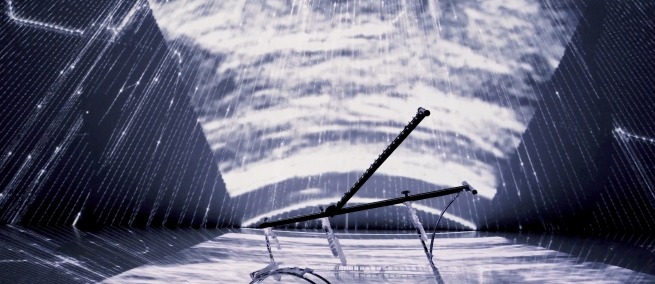
What are the hidden worlds within us and what new ways can we perceive them? How can we de-clinisize, de-pathologize and de-stigmatize representations of that part of us which is hidden beneath the flesh? How can excavating the unseen layers of the human organism permit us to better internalize our human commonalities and connections?
These are some of the questions that can be explored in the exhibition “Overexposed: Art, Technology and the Body” at Museum of the Moving Image and ones which I have been pondering in my works in recent years. These have sought to address such considerations through employing radiology as a means to reveal the full scope of the human organism – an organism so often reduced to the visual qualities and topological form of its surface boundary.
In a prior series, Exquisite Corpus, my work involved creating algorithmically blended volumetric mergers, produced from public control CT datasets, to suggest how the biases of the visual layer mean little to the organism when stripped to this abstracted form. These chimeras, blended of indiscernible races and with little clarity to original genders was intended to demonstrate, with some limitations, the similarities of insides and to draw attention to how the diagnoses of one’s body are frequently controlled by those now hidden elements. Bias and access (or lack there-of) contribute to the way people are diagnosed.
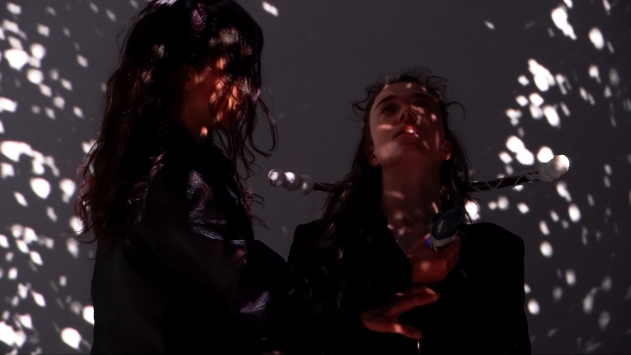
The new performance, Inner Radiance, takes a different approach. It is an attempt to see that obfuscated part of ourselves absent the concerns and stigmas of pathology. By presenting the body’s form without medical or academic concern, we can consider it more holistically. Generally speaking, the interior has traditionally been represented in contexts of the grotesque, or the medical/educational context. Since the technological advancements beginning with Roentgen’s discovery of X-rays, featured in the first X-ray Hand Mit Ringen (1895), this began to change. For the first time, a new class of radiological tools permitted excavations of the subsurface as an abstracted, but non-invasive view. This could escape the associations of the grotesque, but for the most part, and in the case of X-ray technology, these held to the rather sterile field of diagnostic research and pathology. While we’ve gained a greater understanding of the human interior broadly with the use of medical imaging, as long as our organs continue to function within expectation, we continue to be largely unaware of them on an individual basis. We have little awareness of the scope of our individual variations. Even more rarely do we think of those of others beyond our immediate circles. To some extent, this is inattention is deemed desirable in the medical world. As researchers have accumulated greater knowledge from longitudinal studies, it is being realized the frequency with which such tools reveal risk-implying features, that result in no pathology. We are seemingly at odds with seeing these unknowns, concerned that we’ll find something lurking that we’ll miss, while wanting to avoid unsettling discoveries for which treatment might not even be necessary.
In this light, ultrasound can provide an interesting opportunity for artistic presentation. Among its qualities are that the interpolated nature, shadowing and visual artifacts of the phased arrays makes for imagery that is relatively unclear to the untrained eye, yet its style of imagery is almost universally acknowledged as medical. Inner Radiance releases it from diagnostic contexts and brings it into live dance performance. This abstracted layer goes further when built into live three-dimensional volumes, clearly organic in form, yet ephemerally, and indiscernible in presentation. In the context of the immersive venues for which it is designed, the dancers operate within themselves, but, while the audience can see these moving structure and know, through the choreographed and controlled probe motions from whence they come, any attempt to find a medical context becomes lost. One can focus instead on the physical forms moving onstage, and the scanned interiors generated from those bodies as a connected inter-relation of motions and humanity.
I find in many of the artworks in Overexposed that the imagery, being radiological in medium, is medically bound, yet little diagnostic can be gleaned and their practicalities in pathology are eschewed for aesthetic, theory and critique. The artists address complex arrays of bias, control and understanding of the human body that are aided by this abstract presentation; permitting those further considerations of our common interior in all its fragilities and resiliencies. By performatively presenting medical technology beyond its diagnostic contexts, Inner Radiance hopes to provide the same; revealing the wonder of the human organism absent concerns of pathology, and the visual boundary of the flesh. The hope is to inspire considerations on how biases of the body’s visual presentation frequently affect the (inter)personal care of its hidden totality.
♦
TOPICS
SHARE