



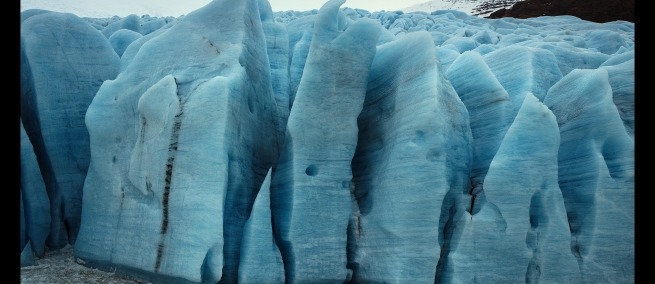
My first encounter with the outwash plain Breiðamerkursandur and the lake Jökulsárlón in southeast Iceland came in 1980. I was in a bus crossing the sandur in pouring rain, the sparsely vegetated black-grey landscape vanishing into the fog. At that time, it seemed a featureless wasteland, telling no tales. Suddenly, a series of hills emerged from the mist on the left, and the road followed them. Then Jökulsárlón appeared, with blue-white icebergs and the heavily crevassed ice margin of Breiðamerkurjökull, an outlet glacier of the Vatnajökull ice cap, entering the lake about two kilometres away. Such a lake, with a glacier terminating in it, is referred to as a terminal or proglacial lake. A powerful glacial river drains it, but flows only a short distance before reaching the turbulent surf of the North Atlantic. Captivating sight, but after crossing it on a narrow bridge it soon disappeared into the rear-view mirror.
Many years later, I stood once more on the shore of the lake, close to where the glacier terminates in the water. This time, in 2024, I was accompanied by a group of American filmmakers shooting footage for ON TIME AND WATER, inspired by the book of the Icelandic author Andri Snær Magnason. They joined me in the field to study the glacier, discuss its changes, and examine relics that tell stories of time. The sun shone brightly, and the view was stunning. Glaciers and icebergs filled one side of the lake, while the narrow bridge lay more than eight kilometres away in the other direction. Forty-four years had passed since my first visit. During that time, Breiðamerkurjökull had retreated by a further six kilometres, and the lake had expanded dramatically. Here, the consequences of a warming climate are unmistakable: the glaciers are melting and disappearing.
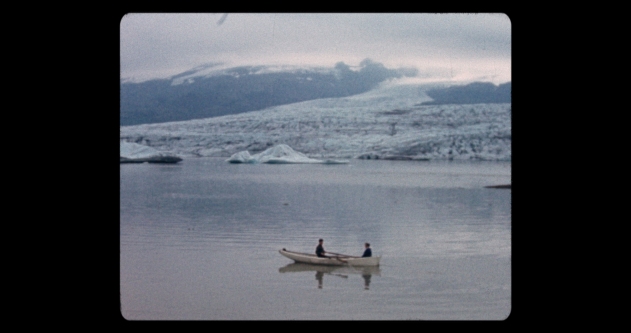
Mother Nature preserves her past differently from humans. Instead of words, she uses signs, colours, and sounds. Understanding this language is not innate, but it can be learned. The gentle movement of the water warns of its extreme cold; anyone falling into it would likely pass into hypothermia before drowning. It also reveals that Jökulsárlón differs from most Icelandic proglacial lakes. Typically, such lakes are muddy and opaque because fine glacial sediment colours the water. Jökulsárlón is different because seawater enters with the tide, making it clearer. Its connection to the sea attracts fish, which in turn support seals that hunt or rest on drifting icebergs. Birds circle overhead in search of food nest nearby during summer. Here, nature demonstrates a remarkable harmony between a seemingly lifeless environment and the ecosystem it sustains.
The cries of gulls interrupt these thoughts. The film crew wants to visit the glacier and capture “...visual glacial phenomena that indicate movement of the ice, the passage of time and marked changes in the landscape,” as they put it. Here, a particular sound is closely linked to ice movement. The predominant sounds are waves, wind, and birds, and otherwise silence. But the silence is often shattered by chunks of ice breaking off the glacier front and crashing into the lake with a thunderous roar. Sometimes the blocks are so large they generate big waves on impact. This process, known as ice calving, occurs frequently because warm saline seawater circulates beneath the glacier front, accelerating melting from below. As a result, icebergs drift across the lake, delighting the tourists gathered near the bridge. Yet few realise the scale of the glacier's sacrifice.
Across the barren sands surrounding the lake, the glacier has left traces of its former presence. Features such as moraines and sedimentary deposits reveal how it shaped the landscape. No human effort was involved, yet tiny tracers from glacier monitoring remain. During the 20th century, glacier observers piled up small boulders for markers or cairns each year to identify the former position of the glacier’s margin. If traced in chronological order, the markers lead only one way, towards the glacier, because it has been retreating continuously for 130 years. On the lake bank rests a boulder weighing several tonnes. No human could move it, yet when the glacier covered this area, it transported the boulder beneath its base and finally pressed it into water-saturated sediments. At that time, the lake did not yet exist. Fractures beneath the boulder testify to the immense force once exerted by the ice.
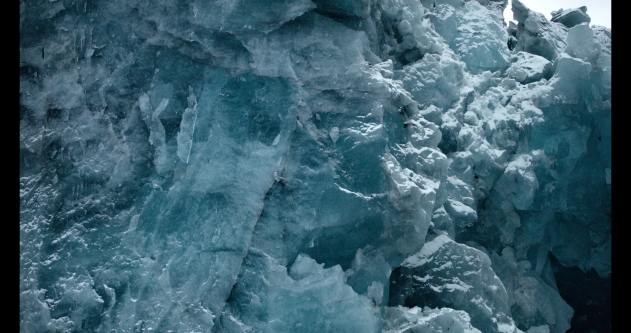
The film crew also wants to see “material that has been frozen in the ice that tells a story of time.“ Occasionally birch branches and plant remains emerge from beneath the retreating glacier. Most are heavily compressed after centuries of burial beneath approximately 300 metres of ice, but some are remarkably well preserved. Radiocarbon dating commonly yields ages between 3,000 and 4,600 years. In one fragment, annual rings could still be counted. The tree had lived for a century about 3,000 years ago. Marine molluscs discovered on the lake shore have been dated to between 5,500 and 9,700 years old. Following the last glacial maximum, before the land rose and vegetation became settled, the sea occupied this region. Some shells bear bite marks from predators, indicating that marine ecosystems once flourished here. Later, as the environment changed, terrestrial vegetation became established. Over a few millennia, this landscape has undergone profound transformation.
This is water and the passage of time as I have come to understand them. Natural processes unfold on timescales very different from those of everyday human experience. The landforms, birch remains, and shells are traces and stories of time that I have encountered. The barren sands, the glacier, and the water are far from devoid of history, contrary to what I imagined as a young man. One realises, with humility, how much can go unnoticed when the environment is ignored or when one lacks the knowledge to read its signs. These are the stories I am able to share with others. ♦
TOPICS
SHARE