


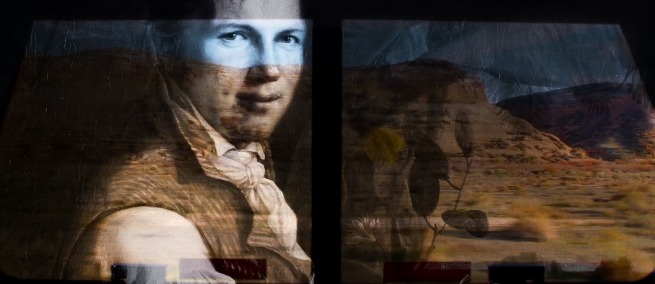
HUMBOLDT USA is a documentary by G. Anthony Svatek that brings the themes of environmentalist Alexander von Humboldt’s work into the present day by focusing on the environmental struggle three places that bear Humboldt’s name. The film was a part of “Working on It” in 2025, MoMI’s work-in-progress section of its film festival First Look. HUMBOLDT USA will have its world premiere at Visions du Réel and then return to MoMI on May 2 for its New York premiere as part of First Look. The film will be co-presented by the ongoing series Science on Screen. We spoke with Anthony about what drew him to Humboldt, what aspects of his scientific research he wanted to include, and the development of the film.
Science & Film: Can you talk about the genesis of this project?
G. Anthony Svatek: I grew up in Austria, and I knew about the name Humboldt, I just didn't really know who the person was. I just knew the name, and I knew that he was a scientist, but not much more than that. And then around 2015 this book called The Invention of Nature came out that became a huge hit and best seller. It paints this picture of Alexander von Humboldt to be this gay, proto-environmentalist, who predicted man-made climate change 200 years ago. The book is a very heroic hagiography of him. And it's a very compelling read, and that's what got me hooked.
I noticed there were these biographical parallels between him and me. He's German, called himself half American. I'm Austrian, half American. We have the same birthday. We're both gay. There are these little biographical parallels that was just like almost a hand, like, waving over here and being like, hello. I just couldn't get him out of my mind. And it became this obsession where I started reading more and more biographies, and there was a more complex image of him as a person, and his impact on Western science and scientific history became clear. And I noticed there were all these names everywhere, all over the globe, specifically in the United States. I found out that he was, at one point, the most well-known, most famous person in the in the Western Hemisphere, next to Napoleon. They knew each other, but they hated each other. And I thought that was such an interesting kind of conceit to track his name and try to see how the shadow that he's cast on science and scientific history manifests itself in these Humboldt place names. So, it wasn't about making another biography about him or biographical film. It was much more about, what are the reverberations in contemporary America, specifically, that speak to his vision of an interconnected world, how science is interconnected with culture, interconnected with history, interconnected with the planet, ecology, all these things that at the time, were quite radical within the scientific, Western paradigm, and that at some point got eclipsed by both Darwin and this kind of technological interconnectedness that I go into as a theme in in the film.
S&F: I remember that book, it certainly felt revelatory.
GS: Yeah, I mean, he's the most used namesake in the world. There are more species, things, and places named after him than anybody else in history. But he didn't name any of them himself. He was never in any of the Humboldt place names, except for the Humboldt Current off the coast of Chile. He didn't name those things. He just became so well known that all these Western pioneers and colonists and scientists, they had his name in mind as they explored these places. They just slapped his name onto whatever they could find.
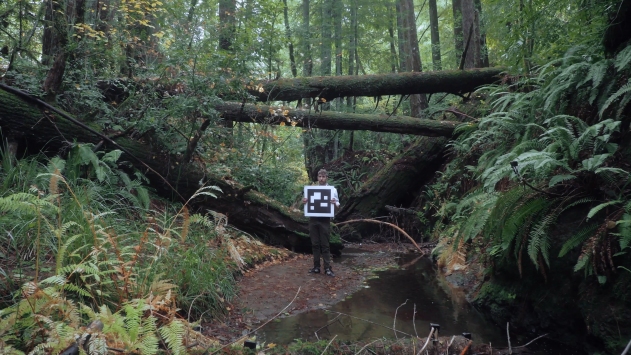
Still from HUMBOLDT USA
S&F: How did you home in on the aspect of Humboldt's science that you wanted to depict in the film?
GS: What's so hard in sort of pitching Humboldt as a person is that he touched on everything. He was such a polymath. He wrote about history and world history, and he wrote about volcanoes, he wrote about the oceans. He was a raging abolitionist, and whenever it was safe for him to, he railed against the colonial system set up by the European powers, even though he very much worked within that system as well. So there's this extra complication, right? But what it all comes back to is this extremely broad idea: everything is interconnectedness. The German phrase is Alles ist Wechselwirkung, which, to me, is almost like a trite thing to say nowadays, but I feel like the meaning of interconnectedness has changed so much and his meaning of interconnectedness has been eclipsed by this technological, infrastructural, economical interconnectedness that he would have very much proposed as well, and would have been in favor of. He was all about sharing information. He was all about development and making a network that spans across the globe of information sharing.
But now we're 200 years later. We're sort of at the tail end of that development, right? He said all these things at the advent of the Industrial Revolution and a fossil fuel based capitalist system. And now we're at the other side of that, and we're more disconnected from each other, the natural world, ourselves, than ever before. So this interconnectedness, I wanted that to be reflected in these three story lines that are explored in the film.
S&F: Your film was a participant in our "Working on It" section of First Look last year, and this year you'll be presenting the New York premiere with us. Can you talk about how the experience of Working on It informed the film?
GS: We were so lucky to have been asked to participate in the work in progress section, which I had attended for many years, and I saw how fruitful it was for various film teams. It also opened a space for some safe vulnerability and feedback. Specifically, I want to mention Kaija Siirala. A co-editor on the film. For months it was just the two of us talking to each other. And there comes a point where there is enough material, it has all these open question marks and unclosed loops, and it's okay to start showing that to the world and seeing what the reaction is.
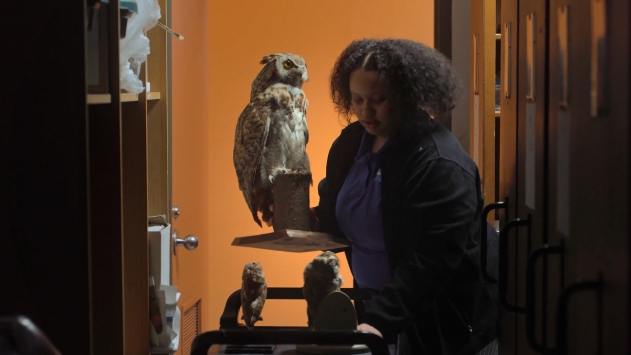
Still from HUMBOLDT USA
And it was so, so great doing it at that point, because I had been wrestling with this question of like, is this an idea driven film, or is this more a humanist kind of observational film? And at that point, when we showed it in March last year, I hadn't entirely made up my mind yet. I wasn't even sure whether the voiceover would be part of it, but it was very, very clear after that screening that the folks who were in the audience reacted so much to the sense of humor, the kind of interpersonal quality, the observational style, and also kind of the warmth that does kind of come through in the material. And I didn't know whether that would translate, or how that would land, and that was the first kind of indication of, like, oh, you know what this film is, it's not a more academic, removed, sober and cold exploration of an idea. It really is driven by these observational scenes that we filmed with the participants in the film. And so ultimately, we really leaned into that more and more, and I think that makes the film stronger. I've made films before that play with humor and sort of use that as a way to reach out to the audience. And here, you can laugh at this, you can feel embraced. That gives you access to the ideas and the topics that are quite dire and that are quite dark in a way, but it's okay to bring you along. And so the WIP screening really was pivotal in that regard, and I'm very grateful for it. I'm very, very proud of that process.
S&F: I'm curious about your relationship to Humboldt now, having made the film.
GS: So the arc of the of the voiceover is this idea of a love letter from me to him, because that's how it started for me. I did really feel like I fell in love with him throughout time and in history. And the more time you spend with someone and someone's ideas, the more complex they become, the more dark stuff you see, too, and the more you wrestle with them as well, but that just means you're getting closer to a truer picture and understanding of who they are. And so the film traces that kind of trajectory. It starts off kind of rose-tinted, and then at some point shifts, and the tone of the film shifts as well, and a more nuanced, complicated, complex portrait emerges, and I'm now on the other end of that. We finished the film in the fall last year, and I took a break, a well-deserved break from work for about a month. But I have since started new work and new projects, and that has, in many ways, helped in letting go. I say that now as the film is released into the world, so I'll probably get thrown back in. But, you know, it felt like an encounter with Humboldt through people who I met in these Humboldt towns. They all represent a tiny bit, like a mosaic and collage of who Humboldt was, who I believe Humboldt was, and I feel very much enriched by that, and extremely grateful. I've learned a lot as about me as a filmmaker, as an artist, and collaborations and interdependence.
♦
TOPICS
SHARE