



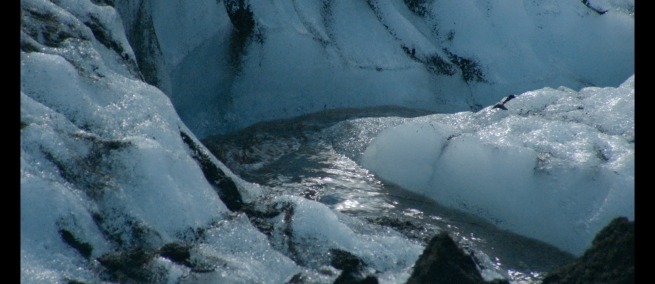
Resistance. Abrasion. Percussive interactions resound. The audible, frictive movements of literary inscription fill an otherwise silent soundscape. As pencil meets paper, the energetic rhythms of omnidirectional scribbling can be heard against a black screen. And so, while you can’t see those words, you can hear them. Someone is writing a letter to the future. Or wait, is it the flicker of a photo projector?
The documentary, TIME AND WATER, directed by Sara Dosa, begins with sound. While audiences stare at a black screen, they hear the haptic sounds of paper shuffling, frictive writing, or the "clicks" of a photo projector. After a few moments, the protagonist and narrator of the film, Andri Snær Magnason, says, “Hello. I cannot send you a glacier, but I can send you this.” What follows is a heartfelt story about how Andri copes with the loss of loved ones and glaciers as he has always known them. His letter is both metaphorical and literal; one marked by personal solastalgia, as well as a broader inquiry. It is not simply, “what is Iceland without ice?”, but “what is a planet without a cryosphere?”
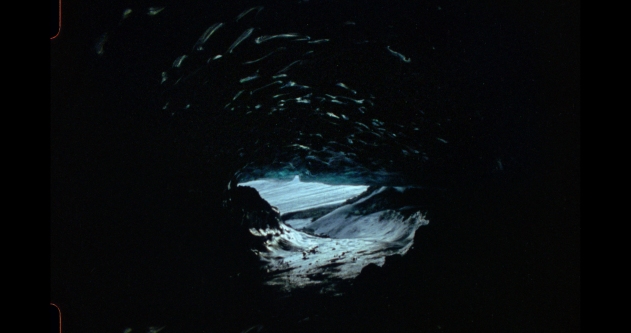
An ice cave in Iceland. (credit: National Geographic)
As an environmental composer and audio-researcher, my work centers on how sound and listening mediate our experiences of changing landscapes, as well as how music can serve as a source for environmental knowledge, and a means for climate communication and environmental storytelling. In my role as “glacier sound advisor” for TIME AND WATER, I provided insight and consultation about glacial sounds throughout the development and production process. I also discussed how glacial sounds might inform creative themes of the film. In this way, many of my conversations with Sara and the film’s production team not only focused on the role of glacial sound within the film, but how those creative decisions might shape an intentional perspective of glaciers as sentient, more-than-human entities.
Throughout my own work, it’s clear that glaciers are inherently sonorous. They are not just frozen, immoble landscapes, but are landscapes that move and flow downslope under their own weight. And so, if glaciers are defined by their capacity to move, then they must also be defined by their capacity to create sound—for every movement of glacial ice produces a specific sound. To then extend an anthropomorphic sentience to glaciers would mean that glaciers—as sounding landscapes—have a voice. They can sing, speak, and write letters themselves. Sections of the film are interspersed with macroshots of glacial ice and features, highlighting the ways that the ice inhales and exhales air, circulates fluids, and maintains rhythms akin to a heartbeat.
Moreover, bearing witness to proglacial landscapes is to read the movements and transformation of glaciers within the earth itself. Push moraines, meltwater streams, sediment scrapes, or the remnants of the ancient birch forest “Breiðamörk” described in the film, are but historical, icy engravings. Like a graphic notation score or a hand-written letter, these formations are the silent echoes of a landscape once shaped by moving and sounding ice.
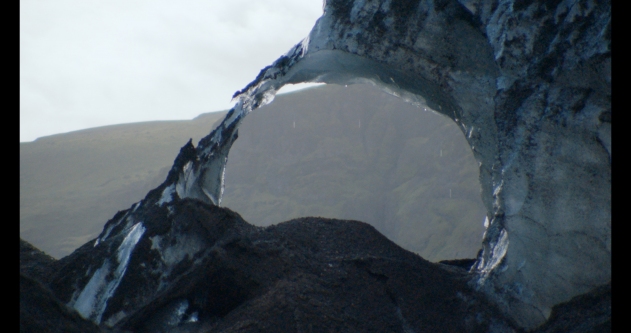
Melting arc made of glacial ice. (credit: National Geographic)
In my own listening, TIME AND WATER attempts to translate these more-than-human messages by comparing the life and death of glaciers with the life and death of people we love most. To then reach across over two-hundred years of generational knowledge is to reach across multiple temporalities that now includes glacial extant. In other words, the film poignantly communicates how geologic time has collapsed within anthropocentric temporalities. Similar to how Andri describes “fuglabjarg” within the film, the term “glacial” (as a qualifier for temporality) no longer means something that moves extremely slowly. For me, “time” and “water” both gain novel significance, as if the time that we measure at 60 bpm now seems to be accelerating a world that now primarily knows glaciers by their melting into water.
When considering the sounds of glacier sentience, the rhythms of life and death, how words and language fail to communicate messages, or the accelerating tempos of “Time and Water,” I can’t help but think of “auscultation”—the diagnostic technique of listening to the human body. In this way, the film seems less like a time-capsule, and more like a stethoscope or the mediating device through which we can listen to the sounds of glaciers in order to diagnose their health. Perhaps this is because auscultation is a technique founded upon the experience of acousmatic sound—that is, an audible sound whose source(s) remain visibly obscured or unseen. After all, this mirrors my own experiences of recording sounds across Iceland’s largest outlet glaciers and ice caps. While I might hear a particular “CRACK” or “RUMBLE,” the many sources that collectively produced those sounds remain beyond my field of vision. And they always will. Listening to glaciers is thus an inherently acousmatic experience.
Ironically, or perhaps poetically, the haptic movements that begin TIME AND WATER are also acousmatic. Audiences might hear “frictive writing” or the “clicks of a photo projector,” but they never see the projector itself, nor the words that compose a letter. Indeed, the invisible sources of those sounds could be any number of things. Sound and listening, therefore, amplify possibility and speculation toward a future. And as Iceland’s glaciers continue to move and sound, TIME AND WATER directs our listening, and reminds us how our own stories are now equally written upon proglacial landscapes to be archived for the future.
♦
TOPICS
SHARE