


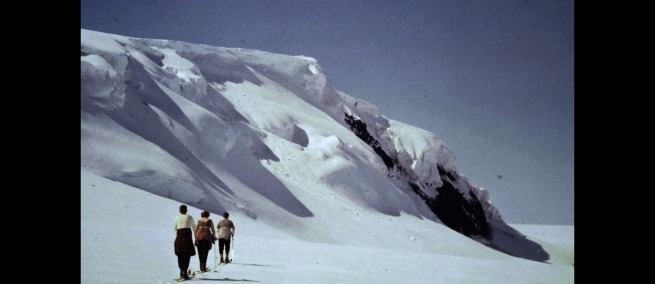
Academy Award-nominated filmmaker Sara Dosa’s new film TIME AND WATER is set in Iceland and interweaves the family archive of writer Andri Snær Magnason with the history of glacial ice in the country. A fixture of the landscape, glaciers are constantly moving, and the effects of climate change are such that they are increasingly slipping into the ocean. Juxtaposing this fact with Andri’s family’s profound relationship with glaciers, the film meditates on living with slow loss. TIME AND WATER is being released theatrically by National Geographic Films together with 1-2 Special and Dogwoof. We interviewed Dosa about her affinity for Iceland, her storytelling technique, and approach to filmmaking.
Science & Film: This is not your first film in Iceland–I'm a big fan of THE SEER AND THE UNSEEN–and I'm curious whether it was Iceland or the glaciers or both that was the initial spark for you.
Sara Dosa: When I really think about it, it's Iceland that was the initial spark, but I feel like Iceland is inextricable from glaciers. Iceland is a place that, for me, just is so awe-inspiring that I really believe you can read a story... I think you can read a story of time into any landscape, but for me, who was not raised in Iceland, the way that you can see the lava flows in the mountains, how the wind sculpts the terrain, the power of the sea, and then the ice. It's such an alive and dynamic world that it really kind of motivates me to think in a different kind of way, to understand different timescales, and both how tiny we are as humans amid it all, and how we have to kind of surrender and give reverence to nature, but also in this moment of the climate crisis, the fact that human activities have become... Andri actually writes about this in his book, he talks about how humans are now as powerful as volcanoes due to the carbon output that we pump out every single day. That [statement] just kind of put something in perspective for me and so thinking about that in a place where glaciers are both so seemingly eternal and yet melting and becoming so fragile or turning into ocean just kind of blows my mind. But I should say, I think it's really the ice of Iceland that feels at once geologic and cultural. That kind of combination is what especially moves me as a filmmaker.
S&F: You do a beautiful job of documenting both the human timescale and the geological timescale. In the process of making the film, you’re working with this family archive, and thinking about time from a human perspective. How did you approach thinking about time from a more of a geological perspective?
SD: Well, that's a great question. I could probably spend years trying to answer it, but I'll try and keep it short. I think for us as a team, and we worked very, very collaboratively, it was always really important to make a film that was polytemporal, where you could feel the past in the present and the future as well. That poly temporality is just how I view time. I don't see time as a line or as an arrow that's kind of barreling from a beginning towards, you know, perhaps an apocalyptic end. I really view time as, as cyclical, as messy, as both rhythmic and arhythmic, and of course it's culturally specific. So making a film that could kind of work with a complex idea of time was important to us. I think Andri does such a beautiful job of getting at that idea through his concept of the handshake of generations. He often will talk about how the future is inhabited by these stories of, you know, dystopia–of BLADE RUNNER, TERMINATOR, etc. but if we can instead understand the future as inhabited by people we love, whether they're blood relatives or chosen family, if we have an outstretched arm or hand towards them, it can really impact what we do in the present, whether it's cherish where we come from, cherish our home, and/or motivate actions that cause us to respect and take care of our environment in a way that will create a more habitable, just future for our descendants.
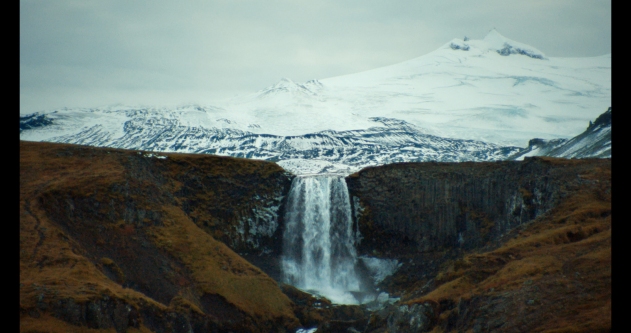
A glacial tongue behind a waterfall. (credit: National Geographic)
Polytemporality had important thematic consequences for the film. We were so lucky to work with Andri's family's archives. I think archives are so interesting, and how they can create a feeling of memory. They, of course, are not memory - all archives are extremely incomplete, but yet getting to work with archives in this film allowed us to tell a story about human memory, both kind of the beautiful life that becomes encoded in our memories, as well as how tragic it can feel to lose your memory, which happens to Andri's grandfather. Also, how glaciers themselves are a repository of planetary memory, kind of frozen in the glacial ice that has accumulated and very tragically, now is being lost. Getting to work with the polytemporality of these different archives was a way to we work with memory to juxtapose the human and the glacial worlds to show a kind of kinship between them and create an emotional resonance, especially for those who might not have their own relationship with a glacier. We hoped that kind of human proxy could be mapped onto that landscape in a way that would feel like it could drum up feelings of empathy for that landscape.
S&F: From your other film, I know in Icelandic lore the landscape is alive in a particular way – thinking about beings like trolls. Did that come up at all in your filming?
SD: It did, yeah, I love those stories about elves, trolls, gnomes, ghosts. There's such a rich kind of history of storytelling about the spirits that inhabit the land in Iceland, and of course many places around the world. But yeah, THE SEER AND THE UNSEEN was all about the elves in the lava field. It was really important to us on every step of the production process to be thinking about the aliveness of nature and the aliveness of glaciers, and that's something that I feel like Pablo Álvarez-Mesa, our DP, powerfully understood when we were shooting in Iceland with both our digital cameras, as well as the Bolex 16 millimeter camera. Pablo was so attuned to feeling the life force of water, and I feel like through his lens he was really able to bring out the enormity of glaciers and get a sense of their movement, even though you know you can't quite see a glacier move with the human eye. I also think our sound team, both our field sound team and post-production sound, which Björn Viktorsson, our sound designer, was with us in the field, and you know, in post, he really understood how important sound was to making glaciers feel like they are moving.
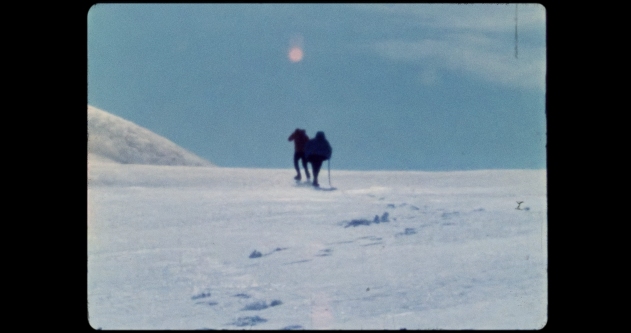
Two people hike up slope in glacier. (credit: Archival Materials Courtesy of Andri Snær Magnason)
Movement is key to the definition of a glacier. And so, if you can hear a glacier move, then you could feel it much more powerfully. We also got to work with a glacial sound advisor named Konstantine Vlasis, who really told us about what he calls the sonic life of glaciers. Getting to work with these different elements in order to make the glaciers just full of life was all the more important in telling a story that's also about a glacier's death.
S&F: Broadly categorized, this is a film about climate change. Was there anything from the sciences that you grappled with how to communicate in this film?
SD: That was one of the biggest challenges with making TIME AND WATER was trying to figure out. I think that the scale of the film itself, because when talking about the climate crisis, but also through a very personal and cultural lens, you could go anywhere. The film, it's not an adaptation of Andri's book but it's very much inspired by his book and his constellation of writings. His book he goes into ocean acidification, he goes much more into the science of carbon, there's so many other scientific aspects that are part of that book that very much grounded our approach but were things that we couldn't address without making the film lose its emotional center. For us, we see our film as kind of one piece in a long conversation, and very important conversation, about the climate crisis. So many people find it very difficult to enter into this conversation, because it's so massive, it's so overwhelming, it's so wrought with complexities. There are so many active campaigns to also dismiss it and obscure the truth of it, the facts, the science of it. And for us, we really thought that if we could locate this story in a very intimate place... Showing how meaningful home is in that way, and to see it be lost because of the climate crisis. We thought that could be an offering to understand the enormity of this issue, but in a very human way. So that meant finding ways to bring in the science as kind of scaffolding, but to also build on knowledge that so many people already have. There has been extraordinary work done in science and climate documentaries that have really spelled out why we are here, how we got here, and what will happen if there isn't extraordinary political, economic, scientific action.
We hope that our film could be kind of that personal lens that could make you feel in a way that would compel you to your own actions rather than provide a kind of scientific or political prescription of what to do. We hope to give the audience agency to make changes or feel on their own terms.
♦
TOPICS
SHARE