



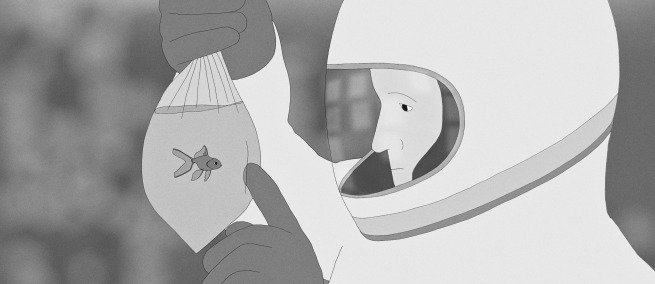
Making its world premiere at the 2026 Venice International Film Festival, Daniel Zvereff’s MOONFISH is an animated feature set in deep space. It follows a lonely astronaut and his companion fish. Morgan Spector and Lucy Liu are the voices. The film is the only animated film in the 2026 Venice Film Festival, and the first animated feature to receive a grant from the Biennale College Cinema. We spoke with Zvereff from Venice about worldbuilding, his inspirations, and the tools he used to make MOONFISH.
Science & Film: I'd like to ask about the time frame–I think there is no time really indicated in the film, but there are certain indicators of progress. And I was just curious how you thought about when you wanted to set this story.
Daniel Zvereff: I was thinking a lot about a very distant future, and I was also thinking about a time when, I guess, if you're looking at it from the perspective of the sci-fi elements, like the ship and the materials and the things that they interact with, it was definitely a time when touch screens and all those things have become a thing of the past. Deep in space things need to be tactile. So there is sort of a retro element in the design of it all, but it's definitely set in a very distant future when people are literally evolving.
S&F: Was there anything in particular that informed how you thought the future might be?
DZ: I was thinking a lot about human beings and what would happen maybe 1,000 years ahead. What I was thinking about was that this is so far in the future that we've colonized the Moon. There are generations of people who have been living there, and I was thinking a lot about this billionaire race to space, and I had this kind of thought in the back of my head that these were all very distant generational relatives to a single billionaire clone, or just something kind of really wild and out there like that. Some sort of pseudo cowboy hat-wearing billionaire was up there and he had cloned himself. And these were the very distant relatives of some of that early colonization of the Moon.
S&F: That's funny.
DZ: It's nowhere in the film, but it was definitely the world I built in my own head.
S&F: I really loved the animation and how bare bones it was in certain respects, but also how detailed and really smooth all the motion was. Can you talk a little bit about the process of coming up with that sort of style of animation, and also the decision to have the film be mostly in black and white?
DZ: I'll speak to the black and white first. I was thinking a lot about what these characters are denied because of the class that they're born into. If you're from Earth, the atmosphere above is blue because there is an atmosphere, and these characters live in a sort of colorless world. The choice of doing four by three was all about the claustrophobia of the environments that they're in as well.
Not unlike the protagonist, I was kind of limited in my resources. So when I was trying to figure out a way to create an animated feature, I knew I had to be really careful with how much detail my characters had. I had to strike a perfect balance between having characters that were sophisticated enough to emote and express emotions, but also could be done with a three-person visual team in a period of a year. I definitely I worked on the film for longer than a year, but a lot of the first six months was me just developing the visual world and the visual style and the aesthetics, and I knew I wanted it to be very simple and elegant. Even if I had more time and more budget, it would have stayed this way. But I definitely was thinking a lot about how to pass off workflow to a small team of people.
S&F: That makes sense. To ask the question that I'm sure everyone asks: Why a fish?
DZ: I was thinking about miners and the use of canaries in the tunnels, and so in space, I think water is an extremely valuable resource, and it just made sense to me that they would be using a fish to test [the water]. It would be the last resort of protection if a sensor or a system fails on the ship, and in the film, it's a little bit more of a superstition.
S&F: Can you talk a bit about the black goop that's in the film? How were you thinking about what that was, if you were to define it?
DZ: What I wanted to show with that was that, although it may be water [that they have access to], it may not be the water that we know, and it may be just the water that they're provided, and there's some sort of a chemical or something that felt like it was a like a corporate form of water or a representation of water that these characters are drinking. I guess not unlike when you drink Dasani, you're not really drinking pure water. There's some salt in there and some other things.
I was also thinking about how these characters may be modified on like a very structural level. They don't even eat, and maybe the water that they consume is water that people like us would not actually be able to consume. And part of the medication that they take is to prevent cellular breakdown from the radiation in space, but also the water that they're ingesting.
S&F: What kind of research did you do to flesh out these backstories?
DZ: Mostly my research was done through googling on the internet and just trying to find little things. But because of the really short timeline, I had to do less sci-fi and a little more fantasy. I drew inspiration from the works of Carlo Rovelli, an Italian quantum physicist who is one of the "founders" of loop quantum gravity theory. His books offer a more poetic and philosophical perspective on time, black holes, and the nature of the cosmos, etc, rather than a strictly technical one. His words influenced some of the themes of interconnectivity and the blurred lines between life and death in the film.
S&F: This is somewhat random, but have you seen SCAVENGER'S REIGN?
DZ: Of course, of course, I have.
S&F: Yeah, it reminded me of your film in I guess just like the feel of it.
DZ: Joe Bennett's work is just incredible. I think there are not too many people that are doing adult animation in the U.S. and there's a lot of us that space stories and obviously Joe does too. I don't know him personally by the way, but I think what he did is something that a lot of people were waiting for. A lot of sci-fi buffs were waiting for something like that to come out, and I actually saw his short film when it came out, which was I think it was just called SCAVENGERS if I'm not mistaken. But it was a Vimeo staff pick and that's what green lit his show. But I remember even seeing that and just being completely astounded by it, and I think in the U.S. we're kind of reaching a moment now where I think because of technology, to be honest, where animation is becoming a bit more democratic and available to people. A lot of the animation I was able to do I was using Procreate and Dreams in early stages, and this is very affordable software on your iPad, and in fact, all the backgrounds of my film are done with Procreate. And I think we're going to see a turning point where we start to see more people doing more sophisticated, elegant adult animation set in space or fantasy worlds and things that a lot of people have been dreaming for, but the industry hasn't been taking the risk on just yet.
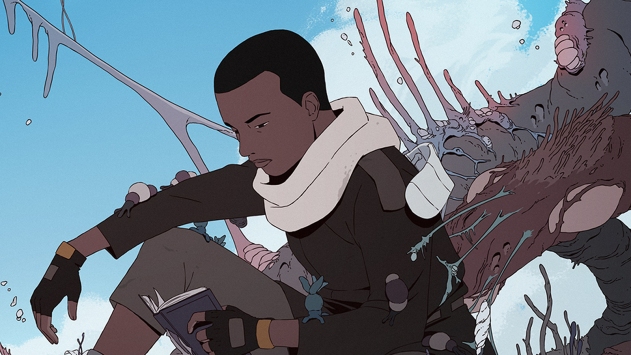
SCAVENGER'S REIGN
Dash Shaw's CRYPTOZOO and FANTASTIC PLANET are like in the same universe in some way. And I really love Dash's work too, and he's definitely someone that was a big inspiration for me to move forward and just say I'm gonna make this happen by myself if I have to.
S&F: Lastly, I'm just curious for any reflections on how it's been being in Venice with the film?
DZ: It's been wonderful. I'm very happy, and I think when you work on something for so long, you feel like the premiere, or at least with this film, I felt like the premiere was just on the horizon perpetually. And even though I was getting closer to it, it still just felt like it was never going to happen. So, even on the day of the premiere, I was not nervous at all because it just didn't seem like it was going to even happen. I stepped out in front of the audience. I was like, Oh wow, I'm actually going to have to watch this film for the 1,000th time. But now I'm finally in the theater with an audience. So, I just feel so extraordinarily blessed to have all my collaborators out here. There's a lot of people who worked so hard on this film. They gave it everything, and we got to kind of share that moment together, which was very special.
♦
TOPICS
SHARE