




Please note: This article contains spoilers.
THE HISTORY OF SOUND, a film directed by Oliver Hermanus, stars Paul Mescal as Lionel Worthing and Josh O’Connor as David White. Based on two short stories, “The History of Sound” and “Origin Stories,” by Ben Shattuck, who also wrote the screenplay, the film is not a “history,” but a beautiful and poignant period drama about the relationship between two men who bond over a love of song and spend the first month of 1919 collecting rural folk music in Maine with an early acoustical recorder.
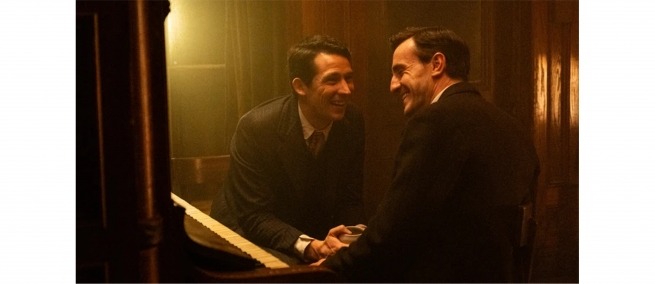
The film opens in 1910, with a young boy wandering Kentucky’s backwoods and streams as the voice of his older self, played by Chris Cooper, recalls, “My father said it was a gift from God. I could see music. I could name the note my mother coughed every morning.” And it took on shape and color “yellow for D . . . taste, too. My father would play a B minor and my mouth went bitter.” We soon learn this is Lionel Worthing, and what he describes is synesthesia, the phenomenon of sensory crossover, allowing one to feel colors, or taste sounds. This quality of neurodivergence sets up Lionel’s character as remarkable, even though he assumed that “everyone could see sound.” His real gift, however, is his singing voice, noticed by the town’s music teacher, who arranges a scholarship to the fictional Northeastern Conservatory in Boston. There in a pub in 1917 he hears David White, a classmate at the Conservatory, playing an upright piano and singing a song familiar to Lionel, one his father played on the fiddle in an earlier scene, “Across the Rocky Mountains.” David insists that Lionel sing, and his a cappella “Silver Dagger” silences the room and stuns David with its purity. The two sing and drink until the wee hours, and stumble back to David’s apartment at dawn. Lionel stays the night and the two become lovers. Lionel learns David acquired his love of English folk ballads as an orphaned child, raised by his English uncle whose maid’s singing inspired him to ask around the village for more songs, which he compiled in a book.
.jpg)
Still from THE HISTORY OF SOUND. Courtesy of Mubi.
Folk song collecting became popular in the late nineteenth and early twentieth centuries as the rapid commercialization of popular music drove fascination with preserving a romanticized past. In 1877 Thomas Edison invented the device that transformed the practice. His tin-foil phonograph was the first device capable of both recording and reproducing sound, which he envisioned primarily as a business tool. After several improvements and the adoption of wax cylinders for recording, anthropologists and folklorists began using the phonograph and competing technologies to record the languages and folk music of indigenous peoples. In 1890, Jesse Walter Fewkes used an Edison cylinder recorder to document the songs, stories, and vocabulary of the Passamaquoddy people of Maine, and in 1907 Frances Densmore began recording the music of Native Americans for the Smithsonian Institution’s Bureau of Ethnology with a Columbia Graphophone. In England, Cecil Sharp, a prolific collector of folk song and dance, tried the phonograph but preferred written notation, while Percy Grainger collected over 350 folk songs on wax cylinders between 1906 and 1909. Clearly, the character of David White is a kindred spirit to these early ethnomusicologists.
In 1917, David is drafted into World War I; classes are suspended, and Lionel, whose eyesight exempts him from the draft, returns “regretfully” to his Kentucky home. Sensing his unhappiness, his mother (Molly Price) says, “just sing something” and tells him if he had never left, he would not now regret returning. Love in this family is impassable and stoic, like many of the songs and ballads we hear throughout the film. Their life is hard, but they enjoy simple pleasures, like the homemade Chinese lantern Lionel’s father (Raphael Sbarge) shows him. He lights the top of a paper cylinder and, as it burns down, the heat inside, less dense than the surrounding air, sends the flaming paper aloft as it burns out. This lighthearted scene portends both Lionel’s brief but intense romantic affair with David and the sudden death of his father, whom Lionel discovers slumped over a tree. Life is short, and lovers, like the lyric in “Come All Ye Fair and Tender Ladies” can be “like a bright star of a summer’s morning, they first appear and then they’re gone.”
Late the following year, Lionel receives a letter from David, who has returned from the war. The letter begins, “My dearest silver-throated Confederate,” and tells Lionel to meet him in Maine where they can take long walks in the woods, camp out, and record the music of rural folk. Equipped with thirty-six wax cylinders and an Edison Standard Phonograph from the Music Department at Bowdoin College where David now teaches, they embark on the song collecting adventure that is the heart of the film. “I’ll teach you to use this. I’ll transcribe the lyrics,” David says. “What we’re looking for isn’t in towns. You’ll find it out there.” Out there they go into the “boreal wilderness,” to walk through woods, set campfires, sleep in a tent, and visit locals to record their songs.
During one such session with a mother and her children, as Lionel prepares the device, he describes to the children how the phonograph works. “See this?” pointing to the cylinder, “It’s made of wax, like your candle.” Incredulous, the boy asks, “How’s that catch sound?” Lionel explains that though sound is invisible, it can be physical, can touch something, can make an impression. Instructing the children to put their hands to their throats as they hum, he demonstrates the conduction of sound through the body, something Edison knew well. Because of his deafness, Edison had to “feel” sound by biting his piano and his music boxes. After the mother asks if she will feel anything, assured by David she will not, she sings a lilting “Grieved Soul” and is joined by her children in harmony.
.jpg)
Still from THE HISTORY OF SOUND. Courtesy of Mubi.
Toward the end of their collecting, David and Lionel travel by boat to Malaga Island, where David hopes to record the songs of the emancipated slaves and Irish immigrants who are about to be evicted by the state, an actual historical event that took place in 1912. “Poor immigrants and former slaves would make for strange old music, no?” David asks, to which Lionel replies, “Doesn’t make you feel uncomfortable?” David explains the salesmanship of collecting by making it an invitation, “lying if you want to call it that,” making it “easier for someone to be generous.” David convinces the initially reluctant schoolteacher to allow their recording by telling her they are collecting songs for a booklet to “preserve America’s heritage.” A powerfully sacred “Here in the Vineyard” sung by Thankful Mary Swain is among the most moving of the many traditional songs in the film, most of them arranged by, and some performed by, Sam Amidon.
The song collecting trip over, David and Lionel part ways at the Augusta train station, with a half-hearted promise by David to return next summer. Lionel’s monthly letters to David go unanswered. By 1923 he has moved to Rome where he sings with a male choir and takes a young male Italian cellist as lover, then to Oxford where he directs the men’s choir and acquires a posh English girlfriend. The relationships all end abruptly, by Lionel’s choice. Like the character in “Silver Dagger,” he leaves a chain of broken hearts. “My daddy was a handsome devil, he's got a chain five miles long. And on every link a heart does dangle, of another maid he's loved and wronged.” Unable to forget David, Lionel travels to Bowdoin College to find him. There he learns that David passed away during his second year of teaching in 1920, that there was no department sanctioned song collecting trip, and that David had a wife, Belle, who reveals that David took his own life.
A clever feature of THE HISTORY OF SOUND is how the songs, ballads, hymns, and even the drinking songs and dance reels often subtly reflect the mood, actions, and emotions of the characters. In 1927, seeking to cling to David even in death, Lionel makes a trek to the Lake District where David once told him he’d heard the best voice ever, “including yours.” Lionel loses his way, stays with a couple who tell him how far he is from his destination, and as he returns, we hear strains of “The Unquiet Grave,” with the lyric, “since I lost my one true love, what can I do but mourn?” David had once described the song to Lionel as a lament in where the singer tells their lover sitting on the grave to move on so they can be at peace and enjoy life while it lasts. “Go live your life.”
Next, we see Lionel, now a professor in his 80s, being interviewed on television about his recent book, Roots and Branches of American Ballads. Reflecting on what sparked his interest, he recalls being “never as happy as I was when collecting songs.” In reply to a student’s recent question about what he liked about folk songs, the ballads especially, “I found myself saying that they were the most warm-blooded pieces of music. . . . stories with sadness so great that they were turned to songs as if melody could make hardship lighter.” As he reads from his book, the scene cuts to Lionel at home inserting a cassette of Joy Division’s album Unknown Pleasures in his tape deck, and the opening bars of “Atmosphere” play under his reading, another apt choice of song. This post-punk band was known for moody, melancholy music, and the singer, like David, took his own life.
In the final scene, Lionel comes home to find a package on his doorstep, the battered leather suitcase of wax cylinders sent to him by a stranger who now lives in Belle’s old house and saw his television interview. Selecting the record marked October 1920 he inserts the cylinder on his home phonograph and, hearing David’s scratchy “Hello, Lionel” he slumps over, masterfully performing the line from the short story: “My heart hurt like it had been kicked.” Being able to listen to the voices of the dearly departed was one of Edison’s proposed uses for the phonograph.
One of the most engaging aspects of this film is Lionel’s lifelong internal struggle from the time he found his soulmate in David. Their bond extended beyond a physical attraction, and included the shared love of music, of sound, of all the sounds he so longed to have been able to record. “I want the sound of my life,” Lionel declared. “What happens to all the sounds released into the world never captured? I want all of it. The History of Sound.”
TOPICS
SHARE