



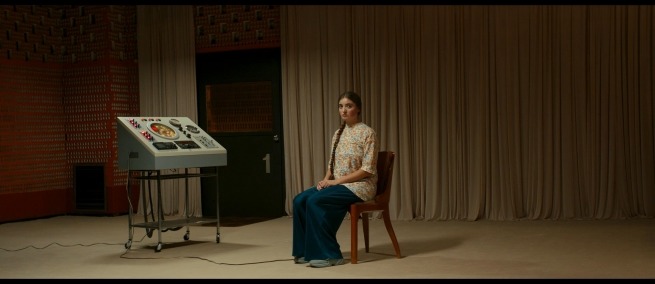
Winner of the Viewpoints Award at the 2025 Tribeca Film Festival, Lucía Garibaldi’s second feature A BRIGHT FUTURE is set in a near-future world not dissimilar to our own. It follows 18-year-old Elisa who is chosen to leave her home and venture “North.” We spoke with Lucía, with the assistance of a translator, about the setting of her film and what it means to be the last woman in a society.
Science & Film: I wanted to start with the plot of the film and the idiosyncratic elements of the present that you take into this near future. How did you come up with this world?
Lucía Garibaldi: The premise might seem very vague. I just wanted to tell the story of the last woman at a certain place. It came to me while I was walking through a place by myself, being the only woman in a dangerous space. So, it just popped in my head, asking, "What if it's actually the reality? What if we explored the last woman in a dangerous place?" Then, to sustain that idea and then shift it to the dystopian futuristic side, I also had to think of more fictional elements. If I'm the actual last woman in a certain place, what are the benefits? What are the dangers? How does my routine look like? How would a normal life look and be structured? And then this idea was also supported by questioning why are the young people leaving this place? What are the certain benefits that are offered in a different place? In the most mundane things or in the most abstract and general ideas, what is being better offered in other places that is not here, and why are people leaving? How to sustain that singular story of the last woman but also trying to understand why her environment is moving to other places, [that’s what I was trying to explore]. Once I realized that I was diving into the science fiction or dystopian element of it all, I also needed to explore the logic of the world, how I was going to play with this imaginary. Because of what was permitted budget-wise, I decided not to focus on special effects or a lot of visual construction, but rather on how do everyday things look, and how can I land a dystopian construction and idea?
S&F: Yeah, I wanted to ask about the production design because it is very striking and beautiful and colorful and, like you're saying, you managed to pull off this futuristic world, but without a lot of special effects. Can you talk about working with the production designer and some of the choices that felt most central?
LG: Yeah, when I first grasped the budget, I realized that what I wanted to do was introduce a world where you think you're seeing something that might be real life, but then it shifts into something very different. So, with budget limitations, I decided to embrace playing with how you would understand the world, based on films like ALPHAVILLE, ANOTHER EARTH... Those kind kinds of films. We chatted a lot with our art director, and we really wanted to set a very specific time frame. We thought about Havana, for instance, a place that was constructed for something that could not be achieved, or a place that became something else.
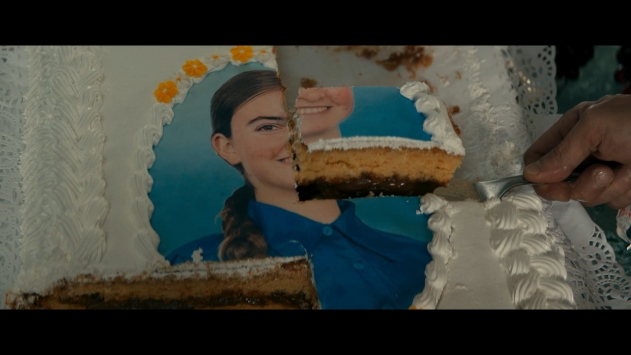
Also, Montevideo in Uruguay certainly inspired the world building. In the 50s when it had a very promising economic growth, it was often nicknamed as the Switzerland of America, which of course later shifted, and it looks like a place that was stuck into something that never fully got to develop. I think that's very engraved in our way of being in Uruguay, just like always grasping at these things that were supposed to turn into something else, but then didn't, and that are markers of that specific unfulfilled future. That's why in the film, you know, the residential complex where Elisa lives, but also the place where the final ceremony takes place, they look like temporal markers that are not even between a past and future. That is why we imagine all the retro-futurism. Because it was really close to our reality. I mean, you just have to look deep, avoid certain things, and you have 90s in Montevideo.
Things that we decided had to be crucial was how TV was going to look like, because it was going to set the tone for the entire universe. So we wanted a plasma but that wasn't thin but rather thick, and that also had speakers in a very like early 2000s kind of way. Then based on that equipment, we started thinking: Does this world have CDs or any other materials? Yes, but let's maybe not show them that drastically. And we kept playing with a lot of things. If we saw a modern car, we would just cover it with a silvery cover. And then if we ran out of those, we would just throw in blankets from our own family, trying to hide a lot of modern things. So it really wasn't a process about creating new sets or anything, but rather just hiding certain things and playing around with what we already had. The same with the VFX. The VFX were erasing things mostly.
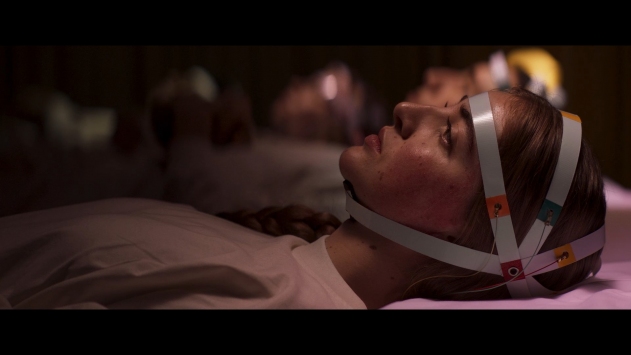
S&F: There is this idea about youth in the film, that it is precious. You were saying earlier that you thought of this film 10 years ago... How do ideas of motherhood figure into this story, thinking about the last person and the last person being a woman?
LG: Just a brief parenthesis before I respond to this is that I was watching THE APARTMENT by Billy Wilder earlier because I'm prepping a class and I have to talk about it, and I was just very surprised to see a young actress frown and having expression lines in her forehead, just because it's impossible right now. Like you can't genuinely see aging marks on faces anymore, and it's crazy to think about a Billy Wilder film as a dystopian mark. When I was thinking about my film, it was already pretty clear and pretty delirious how youth is very fetishized. But in these past years, it's just impressive to see the progressive growth that this fixation on youthfulness has had.
It's important to know that I became a mom in the process of making this film. Of course, also in your 30s I think it's a specific decade where you're constantly thinking about youth precisely because, in terms of society, that’s a decade when your body starts to progressively slow down or not work as it used to in previous decades. I think it was just a time in my life where I constantly reflected about youth. Something I also enhanced while becoming a mother was Elisa's bond with her mom. That just illuminated my perspective on the story from another lens, and that's why I wanted to emphasize a lot their bond and how her mother treats her and how their dynamic is constructed. It used to be unimaginable to understand what you feel when your child is leaving or going someplace else. It never clicks your brain until you actually become a mother.
♦
TOPICS
SHARE