


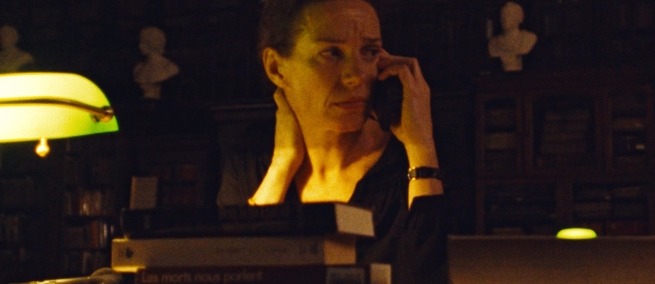
Though it is largely set in present-day Manhattan, the wondrously anachronistic CHRONOVISOR unfolds in a cloistered setting, a scholar’s milieu with old libraries that stay open all night. Filmed in evocatively grainy 16mm, Jack Auen and Kevin Walker’s new film is a speculative science fiction mystery based on their exhaustive research about a mind-boggling invention that probably didn’t exist. Like the invention, the film is a marvelous analog contraption. It immerses viewers in a forgotten world where research takes place using dusty old books and fading newspapers rather than on the internet.
The heroine, played in a truly remarkable performance by non-actor Anne Laure Sellier, who is a real-life professor of behavioral science, is Columbia University professor Béatrice Courte. The current object of her fascination is the work of the late Pellegrino Ernetti, a Benedictine monk, musicologist, and physicist who claimed to have invented a machine that could retrieve images and sounds from the past, including the crucifixion of Christ. Most likely a hoax, this reported invention and the conspiracy theories it sparked inspired this mysterious and seductive film, which foregoes traditional special effects frequently in favor of images of text from the research material on screen. It’s something like Harry Potter envisioned by avant-garde filmmaker Hollis Frampton with a target audience that definitely includes readers of Sloan Science and Film. It ends with a psychedelic passage worthy, in its own way, of the Stargate sequence from Stanley Kubrick’s 2001. A film about the distant past, with a score filled with Gustav Holst music and Gregorian chants, it is also a movie that has a lot to say about cinema, another invention that brings the past to life using sound and image.
CHRONOVISOR premiered this year at the Rotterdam International Film Festival, was a highlight of New Directors/New Films, and is being released theatrically by Grasshopper Films on September 4. We spoke with the co-directors a week before the film’s opening.
Science & Film: When you asked Anne Laure Sellier to be in your film, you told her you were interested in doing an academic noir. That made me curious about your background. You’ve described yourselves as “wannabe academics.”
Kevin Walker: Yeah, wannabe, very much so. We’ve always had a studious bent; we really love reading. And we've wanted to find ways to incorporate that love into our films. We also love things like noir, and moody atmosphere pieces. That's why we love Borges and Umberto Eco so much. Working in that space has always been a dream, but we hadn't really come across a project that made sense for it. Once we discovered the chronovisor and started developing that story, we thought we could really do all this fun atmospheric academia. We love In the Name of the Rose and Harry Potter especially, The Secret History. We just find that stuff fun. And hopefully other people will too.
S&F: I read that the project started as a documentary, and I'm sure you're always asked about what's real about the science in the film.
JA: Kevin stumbled across the conspiracy theory and brought it to me. We became obsessed with it as a conspiracy theory, not really thinking about its relationship to a potential piece of art, and just fell down the rabbit hole. Kevin started buying all these books and magazine articles… He cut together a very early prototype of what became the ending scene of the film, as a standalone speculative fiction. We enjoyed that and found it interesting but it did not scratch the itch fully that we had with the device and we started talking about whether that could be part of something larger. From that point on it was always fictional.
S&F: I feel like this film is about two different inventions. One is the chronovisor, but the other is cinema. I think the film has a lot to say about how cinema works. In the most basic sense, cinema is a machine that lets us revisit the past.
KW: I think that's a totally legitimate, justifiable interpretation of the movie. And it's been really cool to hear people talk about how the film explores image-making and our relationship with the past and with minds of the past. I do not remember discussing anything about cinema during the writing, shooting, or editing of the film. We don't really care to make a statement about cinema.
JA: There's an extent to which cinema is a subset of media and technology at large, it's one example of a broader thing. Obviously this type of device inspires so many cool thoughts about a million things, and I wouldn't want to constrict the universe of the interpretive space down to technology or cinema or anything like that.
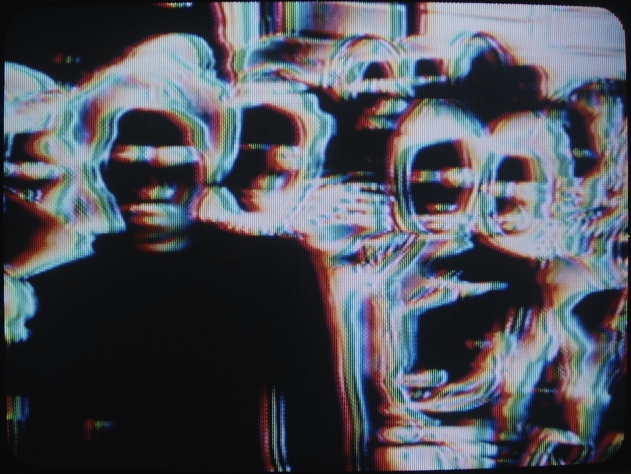
Still from CHRONOVISOR, courtesy of Grasshopper Film
S&F: You made some key aesthetic decisions regarding the cinematic tools you used. The most basic one was to shoot in analog, on 16mm. Somehow that connects to what the story is about. It makes the film almost feel like a piece of evidence, or an artifact.
JA: I guess what I could say is that 16mm was the only choice. It was the obvious choice to convey the tactile nature of the analog materials that are so prominent in the film, and also to help give credence to what could otherwise be incredible in the literal sense of story. And to make it feel like another piece of evidence in the conspiracy.
S&F: And of course it creates an atmosphere that is so interesting.
JA: Selfishly, there's also a bit of a bucket list item on our end to shoot 16mm.
S&F: I just love the moodiness of it, and the way you portray the city. You show a very cloistered, archaic side of the city.
KW: We spend a lot of time in museums and libraries. Almost every other day I'm at the New York Society Library and I live right by the Met. We gravitate to those spaces in New York City. It’s just how we live in New York. We walk around late at night. And we like it like that. So we put it in the movie.
S&F: I love seeing all the late night libraries.
KW: No one brings that up! We thought it was kind of funny. You can't stay at a library after seven or eight in New York. [In the film,] she's in at midnight taking phone calls. It’s very unreal.
S&F: The film feels so subjective; the music helps put you inside the mind of a scientist. I wonder if you could talk about that because a scientist gets so wrapped up in their research, it’s like they really are in a rabbit hole.
JA: We were both very blessed in our education with professors who gave us that love, in terms of the content, but also the process of the learning and discovery. We both took Latin in high school, which was formative. So we've always had romantic grand associations with this type of work. We felt that the music would be a tool to communicate that, about what is otherwise a quite intimate, quiet activity. But it doesn't always feel like it when you're doing it.
S&F: Anne Laure is great in the film. It’s uncanny how expressive her face is, and how authentic she is in the role.
KW: Jack found her by combing through the NYU website because we gave up on hiring a professional actor pretty quickly. There was no one that could do it, that could do the languages, that could deliver the dialogue believably. Jack found her and we found a TED Talk of hers and she was amazing. She has this great face and really matched the character aesthetically as we had imagined. Her voice and her accent and her ability with these quadrilingual monologues, she was just a perfect fit. It's miraculous that she responded to us. And then her performance blew us away. Her dedication to the role, the time commitment, memorizing all this stuff. She was unbelievable.
And yes, she’s particularly good at reaction shots. We would throw her 20 different directions, all of which were probably bad. And she'd somehow take what we were saying and produce some very subtle but realistic and just perfectly pitched facial expression. We had unlimited reaction shots that we could edit with because she gave us every imaginable face and iteration of mood.
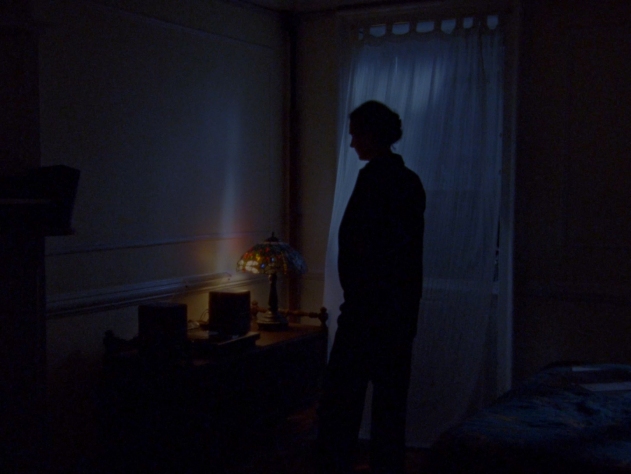
Anne Laure Sellier, Courtesy of Grasshopper Film
JA: All without knowing much about the actual conspiracy theory, because it's not like she was reading all of those texts on screen. So a lot of her experience of learning about the device was like watching the movie in the end. She said “I didn't realize there was all this evidence,” so she didn't know what she was reacting to, but she crushed it.
S&F: I think of it as a film about an invention, but that aspect where the church is trying to hide it, where you get the idea that certain scientific advances will be considered dangerous by the church, by the state. What was the hook for you? The conspiracy side of it?
KW: There's so many hooks.
JA: It adds to the whole milieu of this interesting forbidden knowledge side of things, like a search for the holy grail or for the fountain of youth, that sort of type of object of desire. We loved the idea of participating in that lineage of storytelling. And the whole Vatican side of it…it’s helpful to have at least one sexy element in our film.
S&F: When you talk about sexy elements, one thing that is very alluring these days is the idea of analog technology in so many different ways, which the film has. I mean, the different machines and books and pens and VHS tapes. 16 millimeter film. Usually when you think of a rabbit hole these days, you think of an internet rabbit hole, but this is a much more physical one.
KW: It’s going to sound contrarian or supercilious or something, but we don't like using technology that much. I kind of wish it was something I could eject from my life. I specifically mean the internet. So there is a nostalgia for a time when technology seemed to have fewer disastrous psychological effects on us. We remember pre-internet technology; we had a healthier relationship to it. The aesthetics of it and pressing buttons and the tactile nature of it, it just disappeared from our lives. We miss it and are drawn to it. That was part of the appeal of the chronovisor. It’s not just some super intelligent AI producing a transcendent, crazy level of technological genius. It's just wires and antennas.
S&F: I want to touch on the spiritual element of the film which I think is really important. There's something about the final sequence…
KW: Yeah. In all our films. These are the most important questions we grapple with as humans. It's hard to address it in words, which is part of the reason we make films. But the relationship between the material and the immaterial, the imminent and the transcendent, the pedestrian and the sublime is something that we're always navigating in every film that we make, towing that line, exploring how people both have negative approaches to it and positive approaches.
Jack and I have different spiritual backgrounds. The alchemy of those, I think, produces a lot of the perspectives that our film has on spiritual matters. But it's a crucial, almost the most vital aspect of how Jack and I think about the film.
♦
TOPICS
SHARE