



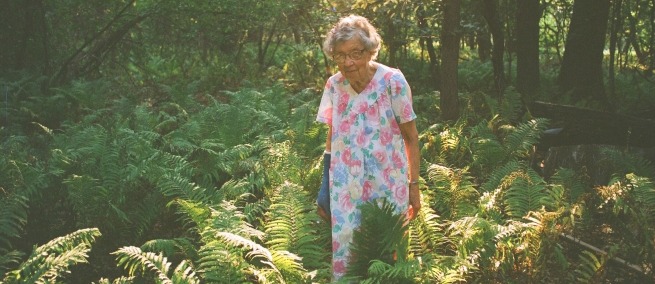
AGATHA’S ALMANAC, which opens theatrically at Film Forum on May 15, is a lovely film that follows director Amalie Atkins’s aunt Agatha, a 92-year-old woman who lives on and from her large vegetable garden in rural Canada. The film follows Agatha as she shows Amalie her life and work—picking vegetables, canning, planting, cooking, and sorting. We spoke with Atkins before the film’s premiere about her choice of camera equipment, the importance of the knowledge that Agatha holds, and what it was like spending this time with her aunt.
Science & Film: Why did you want to make a film about your aunt Agatha?
Amalie Atkins: I first worked with her on two other films; a fiction film called THE DIAMOND EYE ASSEMBLY and REQUIEM FOR WIND AND WATER. So, she appeared as a character in those films. She lives eight hours away from me, so she would travel to Saskatoon, I would ask her to bring certain props, and then at one point in time, I traveled to her in Manitoba, and we shot a scene in her space at the farm. And after I did that shoot, I thought, hold on. I'm gonna finish this project, because I was well into it—it took 10 years to do that other project, but working with her in that space on the farm... I mean, she was great working in Saskatoon on set. She's very comfortable with the crew. It just seemed like she was born to be on camera and born to be on a film set. It seemed very natural to her. It really sealed the deal for me when I went to her space on the farm, which, I mean, I grew up in that space, but somehow shooting there in her world, looking at her world through a lens... I just started noticing all the color that she had around. And I've always loved the kitchen, it is this post-war pink, and the dining room is this mint green. And she has objects that have always been there, objects that have been used by her. So it was her but it was also her space. I was really interested in capturing both, and then also all of this knowledge that she has. Finding a way to hold it before it's gone.
We're losing this knowledge rapidly as people of her generation are dying. She's 92 now, so that was a big reason why I wanted to make the film and to spend time with her. So those two things. The film allowed me to spend way more time with her than I would have if I wasn't doing a project. It gave us long days together, and sometimes I would shoot back-to-back, as we really got going. It's impossible to, you know, get it all in, get a person's life into 86 minutes. But that is why I wanted to do the project.
S&F: Yeah, she does seem to kind of love being on camera.
AA: She's like the monologue queen, you know? She has no qualms about addressing the camera. And going around with her to different festivals too, she's not shy at all. She's very outspoken and opinionated, and she loves meeting people. She's really into the whole thing.
S&F: Thinking about her knowledge of the garden and what you feel is being lost as her generation passes on, is that the kind of knowledge you're referring to?
AA: As I went about shooting and spending time on her property and understanding the value of passing on, you know, she would pass on seeds to me. I live in the city, but I do have a small front plot, and I have pots and her ground cherries, I grow a few every year. I started the Great Canadian Watermelon Growing Contest as a way to encourage other people to grow something. My dad was a farmer and so I grew up in the country. I had my own garden by the age of four—my mom gave me like a four-foot square plot. So early on, I understood it was part of my life.
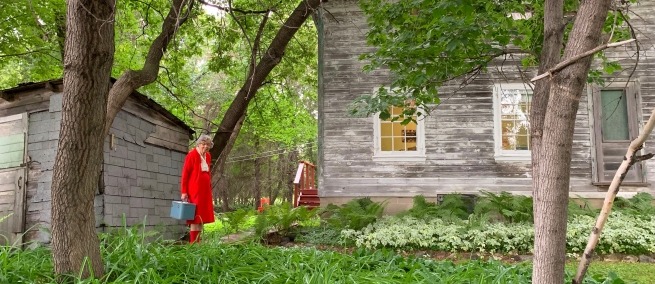
Photo by Amalie Atkins, Courtesy Icarus Films
I have two boys, 12 and 16, and what I see amongst their peers, you know, it's a lot of screen time, and it's a lot of time indoors. It is I think a counterpoint to chaos, the almanac. I edited the whole film. I started the film before the pandemic in 2019 and then once the pandemic hit, it became more difficult to travel and go back and forth. So there are some remotely directed film shoots, like the strawberry scene, for example. But it was this intention of showing another option for people. Not everyone's going to go live on, you know, on a farm and have a giant acreage. But I think what I'm what I'm trying to communicate to audiences now is to spend time in nature, make sure you're getting out into a green space, wherever that is. And I know it's not always easy. If you're in a city, there's not always wide-open spaces, but for example, you can have a house plant, you can have something small. So I think I see the value in what she does where it's so expansive and she's really surrounded by plants.
I'm reading this book by Michael Pollan about plants as being sentient beings. She's surrounded by plants at all times, and I relate to that. I think nature is healing and spending time outside in whatever state you're in, it's always calming on your nervous system. And so what I found through editing during some of the most stressful times of the pandemic... I thought that things would improve in the world.
What my role as an artist and filmmaker is, is to create something that is hopeful, because I don't know what else to do. And the reception for the film has been astounding to me, because when I worked on the project, I wondered, will there be an audience for this kind of work where it's not high drama, it's one woman, there's no antagonist. She's dealing with some pests in the garden and the deer, and her own aging, I suppose. But I didn't know whether there would be an audience for the film. Like Agatha, the film is ever giving. It continually seems to have this rippling effect; a screening seems to open up another screening, opens up another screening as people see it and tell their friends.
S&F: Yeah it's notable how much taking care of everything gives her.
AA: Yeah, it does. The cycles of everything, the processing, the planting, the growing, the maintaining, and then the processing. And in the winter, she's busy quilting. That's what she does all winter. She's making blankets for people. And there's a place that gives blankets to people with AIDS, and she makes these blankets and donates them. So she is really driven to care. To care for her garden and care for people and she cares about, I think, aesthetics too, like color, because it is everywhere in her world, and that's something that I value so much. So it was a joy to be able to spend time in that space with her for as long as we did.
S&F: The way you shot the film is very particular. Can you talk about how the subject matter informed your choices there?
AA: We shot on an ARRI SR2 which did the sync sound, and that lens was beautiful, and could do everything we needed it to do. But when I would go on my own with the Bolex, I discovered the joy of a macro lens. And so being able to get very, very close to things, the seeds and different details in her world seemed to be the best pairing of approaching it technically with being able to get very close to her, the objects in her world. It created this kind of intimacy that I think I wouldn't have been able to do with any other lens.
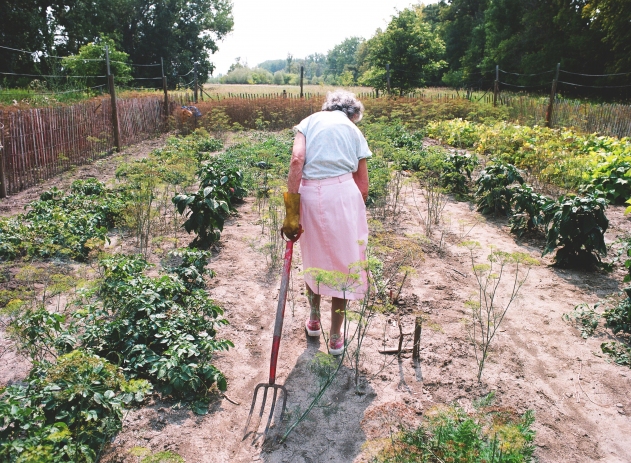
Photo by Amalie Atkins, Courtesy Icarus Films
How she runs her day is how we ran the film shoot. So whatever was going on in her world would be what we would focus on. And so, you know, because of the title using the almanac, I wanted to cover each month, which wasn't as easy as you would think. It sounds straightforward, but the way the film is edited, there's sometimes years between [scenes]. So I think the final scenes where she's walking past this huge tree that had fallen during this rains, it was years before the end of our last shoot. Following the order of the year, that's how I ended up figuring out how to edit the piece together. And she really co-authored the film, I have to say, in many, many ways, at many times. She would decide what could be done, what we were going to shoot. For a couple of years, she wouldn't let me shoot upstairs in the house. I think she thought it was too crowded with boxes, and so I think she spent a couple of years tidying up upstairs. There was a lot of conversation around even what she was wearing. So we worked together on wardrobe, and we'd go through her closet and figure out what she would wear. As she became to trust me as a filmmaker, and forgot that I was her niece sometimes, we'd have really good days where it would feel collaborative and we'd work together on things. So sometimes I would show up and she would be wearing the perfect outfit, but she will always tell the audience that when she works in the garden, she wears a white shirt and these blue striped pants, and she doesn't wear dresses in the garden. And she has a city wardrobe, and then she has her country wardrobe. So the things on the farm, I think, are older things that have stayed there over time. Everything on the farm is really well worn. And that one jacket she has that she's repaired so many times, the purple jacket, that was my favorite. I would ask her to wear that whenever it was cool outside.
♦
TOPICS
SHARE