


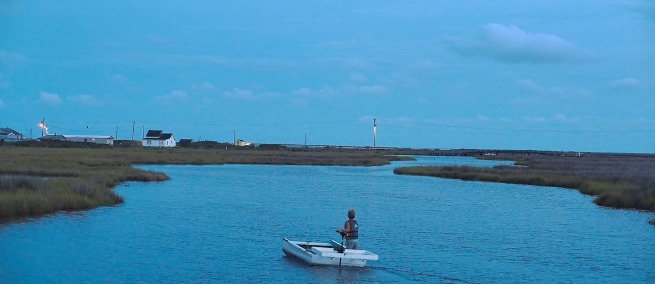
David Usui’s documentary BEEN HERE STAY HERE made its world premiere at IDFA and is now opening in theaters in New York on 5/15 and Los Angeles on 5/27 followed by a national rollout with Grasshopper Film. BEEN HERE STAY HERE follows the people of Tangier Island in the Chesapeake Bay. Their home is just a few feet above sea level. An observational documentary, we see people grappling, or not, with the inevitable future where their home disappears. We spoke with David about his process of filmmaking, why he was drawn to this location, and his relationship to the slow progression of climate change sometimes visible, sometimes invisible, on the island.
Science & Film: What did you find inspiring about the island where you filmed?
David Usui: You know, I feel like there were quite a few things that were inspiring. I was just listening to this book that came out recently called The Blind Spot, and I feel like it's relevant to the work that you do, because the subtitle was Why Science Can't Ignore Human Experience. And the general idea is that one big oversight in science historically, is that we've tried to understand the world objectively by denying the human perspective. And for me, with this film, I felt like it came from a similar place. I first heard about the story through a piece I saw on CNN in 2017, and it sparked a lot of attention on this little island in the Chesapeake Bay that I hadn't heard of before. When I took my first trip there, there were several other journalists on the boat as well, and there were reporters from The New York Times and CBS and The Washington Post, and it just seemed like everyone was going down. And the perspective on the island in the context of the climate crisis that we're experiencing was from that kind of objective, externalized vantage point, which I found really interesting, because it just seems so clear to me that it was missing something big. And so, for me, the big inspiration for the film was trying to find a way to create an experience and to try to embrace a new kind of understanding about our place in the world, about our relationship to the environment. That's what motivated and inspired the approach that we took.
There are no formal interviews in the film. In documentaries, they describe that as an observational or a verité approach. My hope with the film is that that through experiencing this place, by getting close to the community and close to the people, we would understand more than we would if we were sort of finger pointing. The film, rather than really providing explicit questions and providing really clear answers, it is more about just being with the people, about relationships, more than anything else.
S&F: Yeah, I was wondering about the process of gaining the community's trust.
DU: You know, things on the island changed over time. I took my first trip there in early 2018 and making a feature length documentary is always a big investment, and this one was a huge investment for me. I'm based in Brooklyn, and I travelled from New York down to the island on and off over two years and didn't film anything. I really just invested time and was trying to cultivate relationships and to build trust, enough trust that I could get over that initial hurdle. It turned out that the mayor, once they started receiving all this attention through the media, he held a town hall meeting and was trying to contextualize what was happening on the island, and he asked everyone to participate, even if they didn't want to, in interviews and in photos. His perspective was that in order for Tangier to save itself, people needed to know about it.
It's an incredibly private community, and so it was a lot to ask of them [the inhabitants]. On my initial trips, people really were welcoming, and they were really receptive and open to having me and other journalists there on the island, but as the years went on, I think people just generally started to get a little tired. It can be a very invasive process. And I think it just wore them down. There have been over 70 news pieces since that CNN piece came out. And for such a small community, this tiny little island that's the size of Central Park and the floating in the middle of Chesapeake Bay, it's a lot. So, yeah, things changed over time, and I'm glad that I put all of that time into it, because it was a big ask in the end. I feel like with the film, it really paid off.
S&F: How long did it take you to make this film? And were there any significant climate events during the time that you were filming that shifted the conversation?
DU: We spent six years making the film. I spent those first two years traveling and just doing research, relationship building, and then, in the summer of 2020, you know, months into COVID I was lucky enough to raise money for the project, and we started filming then in earnest. The crew that I worked with, we were all based in New York, and so we spent two years traveling from the city down there, and we would spend a week a month there, and we did that for two years, and then spent the better part of two years editing the film. So beginning to end, it took about six years to finish the film.
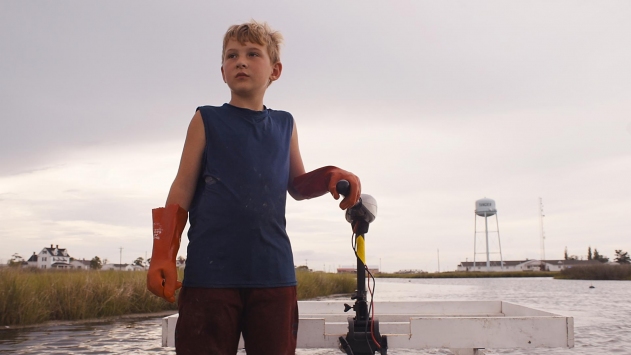
I was trying to avoid filming that I see this as a like a massive natural disaster that's happening in slow motion. There's so much of it that's kind of invisible in a way, and that in order for us to really understand this on a big scale, we need to understand those things, those really small things, and so that comes through attention. It comes through deep listening. It comes through a particular kind of awareness that the world isn't designed to accommodate necessarily. I remember it wasn't even a necessarily big storm. It came as a big surprise. Every year around Halloween, they have a significant high tide. The island itself is almost sitting at sea level. I think it's, on average, about three feet above sea level, which is kind of deceiving, because for me it feels like it's at sea level. And when the sea level rises there, houses go underwater. I forgot exactly how much water there was, but I think it was maybe two feet. There's a moment in the film when the mayor kind of recounts that moment, and he said, I had to kayak to my front door. And he says it so casually that I felt like even without seeing it, it was maybe more impactful to hear how they are living it and trying to keep the sort of stress and anxiety around it at bay just to maintain some sense of normalcy. They assume that [kind of catastrophe] will just kind of come and go, and those are the kind of really quiet, subtle moments that I was trying to find a way of contextualizing and framing.
S&F: I don't know how you could have, but in the process of making the film, did you find yourself wanting to intervene in any way?
DU: I think it's part of the art of it. It's challenging to resist the temptation to really involve yourself in the story, and with observational filmmaking, it's, I think, even more difficult because, as a practice, it's really about staying out of the way. It's like putting your ego aside and just kind of trusting that the intention is enough, that by shining a light on something that you feel like is important, it will do its job, and that by intervening, you're kind of constricting the thing. You're kind of squeezing the life out of the very thing that you're trying to give emphasis to. And I felt that consistently throughout the whole process. But over the years I've just grown more accustomed to kind of pulling back a little bit. And so, you know, over those six years that we're making the film, I don't think I ever once said climate change on that island. And it wasn't a matter of manipulation. It was about giving people space to describe what they see and hear and feel without my influence.
♦
TOPICS
SHARE