



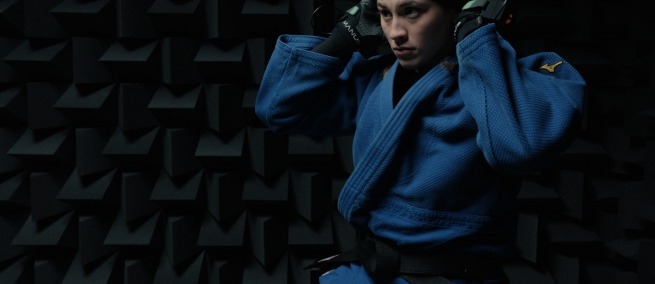
Giulio Bertelli's feature AGON is set in the lead-up to the 2024 Olympic Games of Ludoj. The film follows three women athletes who specialize in rifle shooting, judo, and fencing. The film was awarded the Venice International Critics' Week 2025 Best Debut Feature winner and had its North American premiere at New Directors/New Films. It will be available for streaming on MUBI. We spoke with Bertelli about technology and the body, his influences, and the research that went into the making of the film.
Science & Film: Can you talk about the inception of this project?
Giulio Bertelli: Well, the very inception of the project, the very beginning, I was thinking about, what if I would write for an animation, actually, not a live action film—this was many, many years ago—about a modern Joan of Arc, the medieval, historical figure, in the contemporary context. So I was thinking, what if she's a fencer, and what if she kills someone at the Olympics? And all of a sudden, the Olympics becomes this political, geopolitical kind of backdrop to which she has to undergo trial. And this is because there was, of course, an interest from looking at the historical nature of what we now consider sports and its relationship to the history of warfare. How we went from officers in moments of peace time, training for war, to then actually creating this modern Olympics, or the ancient Greek ones. Athletes are using sports basically as a proxy for war.
S&F: I’m curious about how you filmed the athletes, and the particular preparations they undergo using technology.
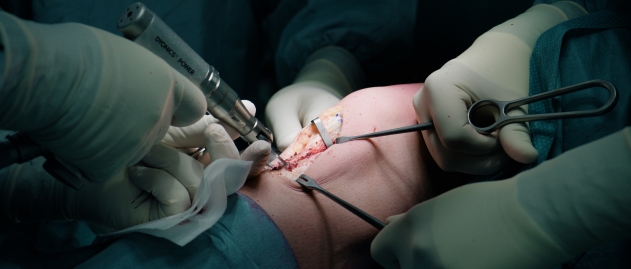
GB: I think that there was an overall interest for me in this intersection between organic matter and technology. And I think the surgery [of the knee in the film] is a very explicit juxtaposition of these two elements. It's literally a technological, robotic kind of element that is human built to carve into the body, and into flesh and blood. So I think this juxtaposition is at the core of some of my main interests that I also would like to explore further in cinema. This served well on how to portray these women in the context of trying to achieve their sport results and all of the sacrifices that comes with it. The film on one hand uses this theoretical kind of wide shot presentation or argument, within which these athletes, this person, this human body, kind of move across trying to get the result. And I think I was interested in looking at the two extremes, so the very visceral, body-like, following the character, and at the same time, the more theoretical macro pattern of what the film is, and what is this investigation about sport.
S&F: I really appreciate how much is done in the film without dialog.
GB: In its writing, there was much more in the script. So the film, as often happens, particularly for a first-time filmmaker, it had different life, and it had different script. At a certain point, the story became, in a way, more contrived, smaller, which I think helps a lot to really not waste any energy in focusing on what we are really trying to do, and what was the story that we were really trying to tell. And the shooting script, or the script prior to pre-production, had more dialogues. But what I realized at the beginning of shooting the film, and then furthermore throughout all of the shooting and in the editing phase, was that the film had its own identity in a way, and I had to let it go where it kind of asked me to. So of course, it's my film, and it's my decision, but it felt like it was asking to be slightly darker than I expected or asking me to be more silent that I'd expected, almost like the spoken words were not helping to convey that sense of solitude or anxiety or pressure [that I wanted to depict].
S&F: What kind of research did you do to learn about the technologies we see depicted?
GB: There was a lot of research done in multiple layers: on each sport, on medicine and sports technology, and in general. A lot of it was kind of already done by myself in the many years of having just a strong interest in video games or interaction-based digital tools. And so, I was aware of what is going on in, let's say, in the world, and where the world is going in terms of all of these digital tools. I just kind of compiled them with the research on all of the specific sports and with my personal experience as a former professional athlete, and I think it kind of landed itself on what was needed, and what was not needed. But, for instance, one specific instance about what I'm talking about is that there is this training tool for learning how to be a better shooter in the virtual world in video games, following yellow spheres on a screen. There are these recurrent kinds of elements, and I was very fascinated by the fact that at a cognitive level, there are a lot of digital tools that come from very different industries, whether it's entertainment, whether it's video games, whether it's medical, but they kind of share the same cognitive pattern. They're kind of built on the same idea. So I was also fascinated by looking at this intersection.
S&F: I happen to have curated an exhibition that's about medical imaging and the body, and how those tools shape how we think about the body. I feel like with your film, there's that feedback loop in the training of the athletes, through digital tools, they become more and more sort of machine like.
GB: Where is this exhibition? Because I'm very interested about that, regardless of the film like, if I could have, I would have made... you know that sequence in the film that you see before the opening titles, there's a CT scan of a knee that kind of slowly turns and then becomes the opening titles.
S&F: I love that.
GB: Yeah, that's a CGI sequence that I made myself using a medical tool. It's made with an off the shelf medical tool, because I was working with the CGI and they just couldn't get what I was trying to do. So I said, guys, I'm just gonna use the real tool. Make it myself. It's going to take like, a week, and that's it.
♦
TOPICS
SHARE