



Spoiler note: except for the overall outcome, no specific plot points are revealed.
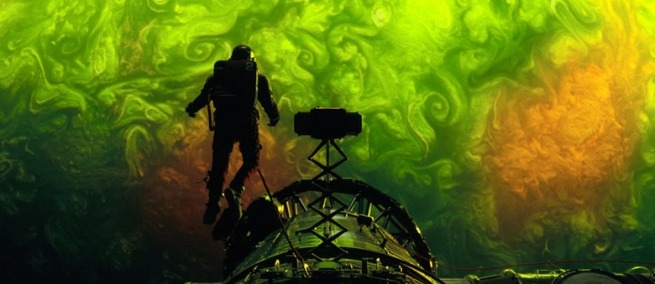
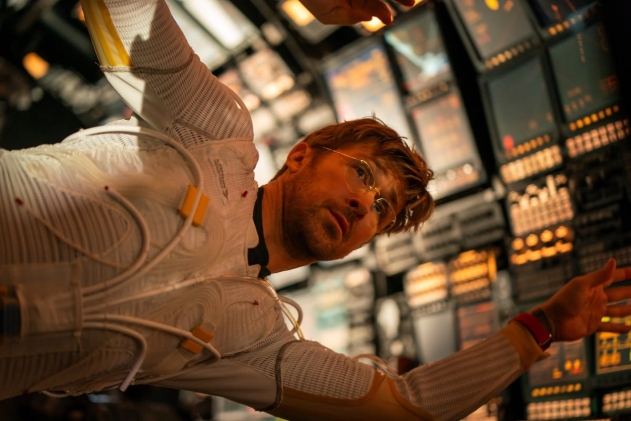
Sci-fi author Andy Weir likes to put his scientist-protagonists in isolated situations where they have to think their way out of a serious problem. The 2015 film THE MARTIAN, based on Weir’s novel, showed how plant biologist and NASA astronaut Mark Watney (Matt Damon) gets accidentally marooned on Mars, where he is completely alone but survives. In the film PROJECT HAIL MARY, adapted from Weir’s book of the same name, molecular biologist and reluctant astronaut Ryland Grace (Ryan Gosling) also finds himself alone, in a sterile high-tech chamber with no idea how he got there. Eventually he – and we – learn that he’s on a starship headed light-years out into space.
As his memory returns, Grace discovers that his goal is to solve a problem bigger than his own survival: the survival of all of humanity. In a few decades the world will suffer catastrophic global cooling because a ravenous microorganism is taking the Sun’s energy for its own life processes.
Grace might seem a poor bet for this task. His theory that alien life does not necessarily need water as Earth life does – long assumed by most biologists in the real world – destroyed his research career. He now teaches middle-school science. But his maverick idea brings him to the attention of Project Hail Mary, the last-ditch international effort to stop the destructive lifeform. Working with the Project, Grace learns more about the organism he names “astrophage” or “star-eater,” such as the fact that it needs CO2 to reproduce. Through a series of unexpected events, he ends up alone on a trip to the star Tau Ceti that is not infected by astrophage and may offer a way to combat it.
However, Grace finds he’s not really alone. He encounters an alien spacecraft and its sole surviving crewmember, a blocky, mineral-like creature (James Ortiz, voice and puppeteer). They find a way to talk and Grace dubs the alien “Rocky.” Rocky’s home planet Erid and his fellow Eridians are also under threat from astrophage attacking their sun. The two are each happy to have company and they bond as they work together. They learn each other’s ways, tell jokes and also squabble like mismatched roommates, and develop mutual trust. Their cooperation pays off when they find a biological way to kill astrophage and save their worlds; and their friendship inspires Grace to save Rocky’s life at a great personal cost, though Grace survives.
The science in the film covers several areas but the main scientific questions swirl around the astrophage. Though it could end humanity, it has desirable properties too, storing vast energies and shielding against radiation. But how could a biological entity possibly live near the Sun and harvest its unimaginable flow of energy? Is Weir’s novel sci-fi idea at all realistic?
In the book Project Hail Mary, Weir works hard to make the astonishing properties of astrophage at least conceivable. The necessary exposition is presented through Grace’s own thoughts and actions as he and others investigate astrophage. Hollywood generally puts story over science, and little of this level of detail survives in the film, but the issues remain and push us past the limits of established biology and physics.
How far beyond the limits of these fields becomes clear if we consider the real biological process of plant photosynthesis. Here too a cell gathers solar energy, which is stored as it initiates chemical reactions that rearrange molecules. But it’s the scale of the energy that lifts the astrophage process to a different level. In the book, scientists aim a powerful laser at a single astrophage cell. It absorbs the light for 25 minutes, then starts reflecting it, showing that it can hold no more energy. This maximum is 1.5 megajoules (1.5x10⁶joules). That’s a lot: it could raise a 3,000-pound auto to the top of a 30-story building. In comparison, the chemical energy stored in a single real photosynthetic cell is in the nanojoule range (10-9 joules), only enough to raise a grain of dust a few feet. Clearly astrophage harvests energy far beyond what ordinary biochemistry can do.

The energy storage is also remarkably compact, with the 1.5 megajoules contained in a microbe-sized cell 10 micrometers (10-5 meters) across. It is a tiny object with a tiny mass, and its energy is concentrated far beyond any real-world energy storage by many orders of magnitude, from fossil fuels to electric batteries, and even nuclear fuel. Yet the cell holds this vast energy without being violently disrupted. Equally unheard of, the absorbed energy does not raise the cell’s temperature. Conventional physics can’t explain this behavior, but the book provides an answer: neutrinos. These are real elementary particles with an extremely small mass that travel near the speed of light and pass nearly entirely undetected through ordinary matter.
In the story, neutrinos are postulated as being created by nuclear interactions in the astrophage cell, and instead of flying off, somehow operate there to manage the incoming energy. This is not possible in present-day physics, as Weir knows. He recently explained that the scenario is deliberately “made-up” and is the “only true violation of physics” in the story. But starting from his premise, Weir consistently and correctly works out its consequences, giving an overall aura of plausibility. I have to wonder, though, about the deeper validity of the exotic physics-biology combination. Early in the history of life in the universe, no living thing could sense or react to neutrinos at a perceptible level; so how would even the enormous flexibility of biological evolution eventually produce an organism that depends on neutrinos for its life cycle?
Other science in the film includes the clever design that uses astrophage to propel Grace’s ship to where he and Rocky discover how to defeat astrophage, a nice irony. The science behind Rocky’s alienness is developed too. When I first saw him on screen, I thought “silicon lifeform!” That’s an idea with some scientific basis that has been used in a STAR TREK episode. Life on Earth is based on the versatile carbon atom. Its four electron clouds pointing in different directions chemically bond to hydrogen, oxygen, nitrogen, phosphorus, and sulfur to create the complex molecules of life. The element silicon also has atoms with four available bonds. One likely connection is to oxygen, producing rock-like and ceramic-like compounds. Life based on these compounds is far less likely than with carbon, but should it develop, the result might look somewhat like Rocky.
Weir, however, takes Rocky in a different direction. The film shows that Rocky and Grace cannot share the same atmosphere, and Grace notes ammonia-like compounds in Rocky’s surroundings. Weir explains this through the environment on Rocky’s home planet, Erid. It orbits the (real) star 40 Eridani A and has a high surface temperature and an ammonia-rich atmosphere at high pressure, which places it outside the conventional habitable zone for liquid water. Grace has found life beyond the established limits of water-based habitability, lending support to his earlier claim. But Rocky’s physiology is more complex than simply replacing water with ammonia, since it also uses water and other fluids such as liquid mercury. Rocky is an intricate lifeform existing outside the usual conditions of Earthly biology.
PROJECT HAIL MARY, the film, strikes a fair balance between conveying the science – though less extensively than the book – and telling a story where a supposedly failed scientist finds he’s a better researcher than he thought. He enjoys teaching science too as we see at the beginning and end of the film. These positive attitudes toward science and teaching are welcome, as are other important messages. In an ultimate example of diversity, a human and an utterly different alien find common ground and friendship. And a world facing climate change should take note: only a serious international commitment like the film’s Project Hail Mary can resolve a global threat.
TOPICS
SHARE