



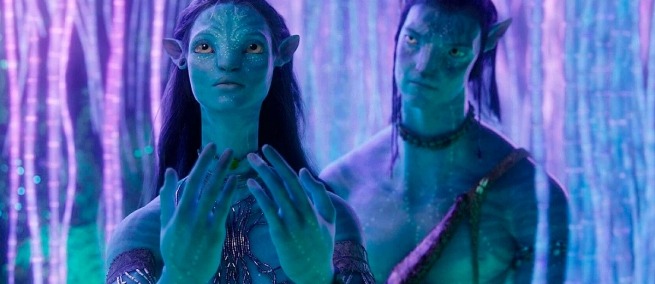
The ecosystems of James Cameron’s planet, Pandora, in the AVATAR films are clearly alien, but with some strong resemblances to those found on Earth. The forests have tall trees, an understory, insect-like organisms buzzing around, and herbivores and predators of a range of sizes. The oceans are home to whale-like beasts, species that resemble giant armoured squid, and lots of organisms that glow with bioluminescence. An intelligent, blue-skinned, bipedal ape-like species has evolved, who call themselves the Na’vi, and they have adapted to live in coastal, arid, and forested environments. If Pandora were real, biologists would conclude that there is some predictability to ecology across planets, with producers, herbivores, and predators routinely evolving, and intelligent ape-like beings being common throughout the cosmos. One way of life that appears to be missing from Pandora are parasites. There are also a few other odd things that don’t stack up about the flora and fauna of Pandora, and that has made me question whether the Na’vi are not quite as straightforward as they appear.
Most of the large forest animals on Pandora are hexapod, meaning they have six legs. The Pa’li, a horse-like herbivore that the Na’vi ride; the Palulukan, a huge apex predator that the Na’vi fear; the rhino-esque Angtsìk; and even the pterodactyl-like aerial ikran and toruk beasts have hexapod body plans. On Earth, insects have six legs, vertebrates have four, and spiders have eight. Evolution has consequently created very successful four, six, and eight limbed species on our home planet, and it is probably chance that all Earth vertebrates have four rather than six or eight limbs. The hexapod body plan of the animals of Pandora is consequently plausible. The problem is the Na’vi. They are apparently the only vertebrate species to have four limbs on Pandora.
On Earth, all vertebrates are related, sharing a common ancestor about half a billion years ago. Scientists think it was a small jawless fish-like animal. Assuming evolution works on Pandora as it does on Earth, the various species found there must have shared a common ancestor, and it seems likely it had a rudimentary hexapod body plan. The Na’vi then appear to have lost two limbs and the associated skeleton to support them, making them quadrupeds. Going from six limbs to four would require a major rework of the Pandoran vertebrate body plan, as the Na’vi have no obvious remnants of having had a six-limbed ancestor.
Limb loss is not impossible. There are animals like snakes without arms and legs, but on close examination it is clear they evolved from a quadruped ancestor. The same cannot be said of the Na’vi, as their body plan is quadrupedal. One possibility is the Na’vi separated from early Pandoran vertebrates very early in their evolutionary history, going on to develop a four-limbed body plan, with all other hexapods evolving from a common ancestor that evolved on another branch of the vertebrate tree of life to the Na’vi. Possible, but a bit of a stretch. Particularly given another widespread feature of life on Pandora.
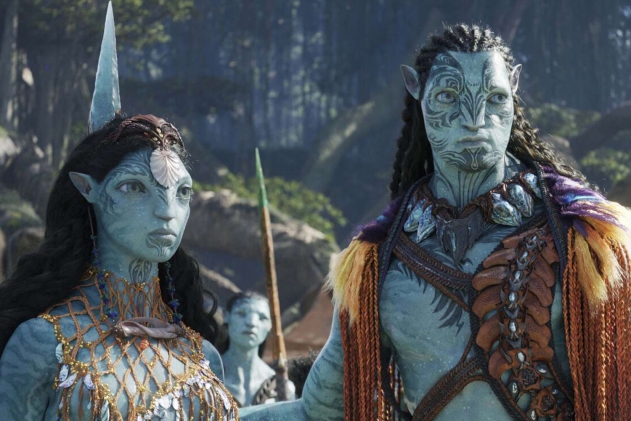
All Pandoran animals, and even the Tree of Souls, have braid-type organs called tswins that they can use to bond with one another. The end of the tswin consists of exposed nerve cell endings that bind with that of another being, forming a neural link, called a tsaheylu, between the two organisms. When a Na’vi rides a Pa’li, Ikran, Toruk or ocean beast, they form a tsaheylu with that of the animal, a connection is made, and the two animals can communicate. The Na’vi can then direct movement of their mount without reins, can feel the animal’s emotional state and override their thought processes, at least to a degree. When the Na’vi bond with another, they experience some sort of emotional resonance and memory exchange.
For such bonding to work, it requires compatibility between neurotransmitters, nerve voltages, and brain structure across species that can bond. On Earth, differences between species in each of these would make bonding impossible. Even if the voltages of nerve signals and neurotransmitters were compatible, I suspect it would be rather undesirable to bond with a pet dog, horse, or squid. We have no idea what it would be like to be a bat, rat, or cat on Earth, and I suspect that is a good thing. It is also unclear why, or how, an adaptation where an individual of one species can take over motor control of another would arise, unless both would benefit in terms of survival and reproduction in everyday interactions. There are perhaps benefits to all life of Pandora in defeating the dastardly human villains intent on plundering the resources of this alien world, but evolution does not have foresight of what adaptations might be useful in the future. The neural bond must have provided all species with an advantage even in the absence of a human threat. Mutualisms, where two species evolve to benefit one another, do arise on Earth, but not to the extent that one animal hands over brain control to another.
The cases where brain function of one animal is altered by another organism on Earth are much more grotesque than on Pandora. Some species of fungi in the genus Ophiocordyceps are parasitic, and they turn some ants into “zombies”, modifying their behaviour. The fungus makes the ant climb to the end of vegetation before killing it. A fungal fruiting body then emerges from the back of the corpse’s head, bursting and spreading fungal spores over a larger area than they would infect if the ant had died on the ground.
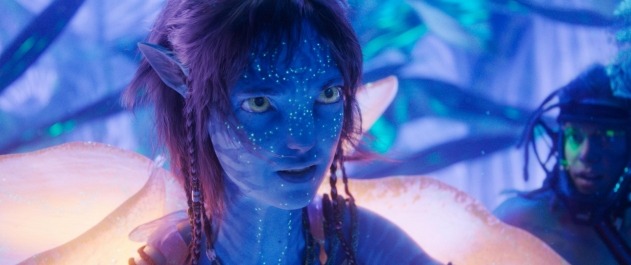
We know little about the long-term consequences to Pandoran animals of bonding with the Na’vi. If the similarities in evolution between Earth and Pandora extend beyond shared aspects of their ecology, perhaps Na’vi are in fact a type of parasite, exploiting the animals that they bond with. If that is indeed the case, we would expect strong selection for the pa’li, ikran, and toruk to lose their tswins. Who knows, perhaps in AVATAR IV this will come to pass. Given the similarity in the story line between AVATAR II and AVATAR III, revealing that the Na’vi are parasites would be a welcome twist.
TOPICS
SHARE